

You have found a company that could change your growth: a distributor with thousands of customers, a software platform your buyers already use, an agency that sells into exactly the market you want. You get a first meeting. Then you open the deck you used to raise money, change the cover to “Partnership opportunity”, and send it.
That deck is accurate. It is also about you. Market size, traction, team, product, vision. A potential partner reads it with a different question in mind: what’s in it for us?
This guide is for founders, business development leads and anyone pitching a partnership to a bigger company. It covers why investor decks fall flat with partners, the five things a partnership deck has to answer, a worked example, the common mistakes, and a checklist to run before you send it.

Why an investor deck doesn’t work on a partner
An investor and a partner are both deciding whether to back you, but they are risking different things.
An investor is buying a share of your company. Their questions are about the size of the opportunity and your ability to capture it: is the market big, can this team win, what could my money return? An investor deck is built to answer those questions, so it leads with the market, the traction and the team.
A partner is not buying anything from you, at least not at first. They are deciding whether to spend things they care about on working with you: their team’s time, their sales people’s attention, and, most of all, their customers’ trust. If your product lets their customers down, it is their name on the complaint.
So their questions are practical and a little defensive:
- What do we get out of this, in terms we already measure?
- What will it cost our team, in hours and attention?
- What could go wrong for our customers, and who fixes it?
- Why work with you instead of building this ourselves or buying someone?
- What is the smallest thing we can say yes to first?
An investor deck answers almost none of these. A market-size slide tells a partner that your market is big. It doesn’t tell them why their business gets better.
The five questions a partnership deck must answer
A good partnership deck is short. In many cases eight to twelve slides are enough, built around five moves, roughly in this order. Each move answers one of the partner’s questions.
Move 1: Start with their goal, in their words
The first content slide should be about the partner, not about you. Name a goal they already have, using the words they use for it. That goal is usually easy to find if you look: their annual report or investor updates, their public sales targets, job ads for the team you would work with, and, above all, what they told you on the first call.
Write it as one sentence they would agree with immediately. “The clinic software market is worth billions” is a fact about your market. “Your reps visit 1,200 clinics a year; give them something new to offer between equipment orders” is a goal they recognize. The second sentence earns the next slide.
If you don’t know their goal yet, the deck isn’t ready. Ask before you design anything.

Move 2: Show why partnering beats doing it alone
Every partner has two other options, even if nobody says them out loud: build the thing themselves, or buy a company that already has it. Your deck is stronger when it puts all three side by side and compares them honestly on time, cost and risk.
Building usually means a long project and a new team they have to manage. Buying usually means months of negotiation and a large, up-front bet. Partnering with you should win on something concrete: live in weeks rather than months, paid through a revenue share rather than a budget line, and tested with a small pilot before anyone commits to more.
Then add the proof that you can deliver what you promise. Not the vision, the evidence: how many customers already use the product, how long setup takes, which similar companies you already work with. Show what you have done, not what you plan.
Move 3: Say who does what, on both sides
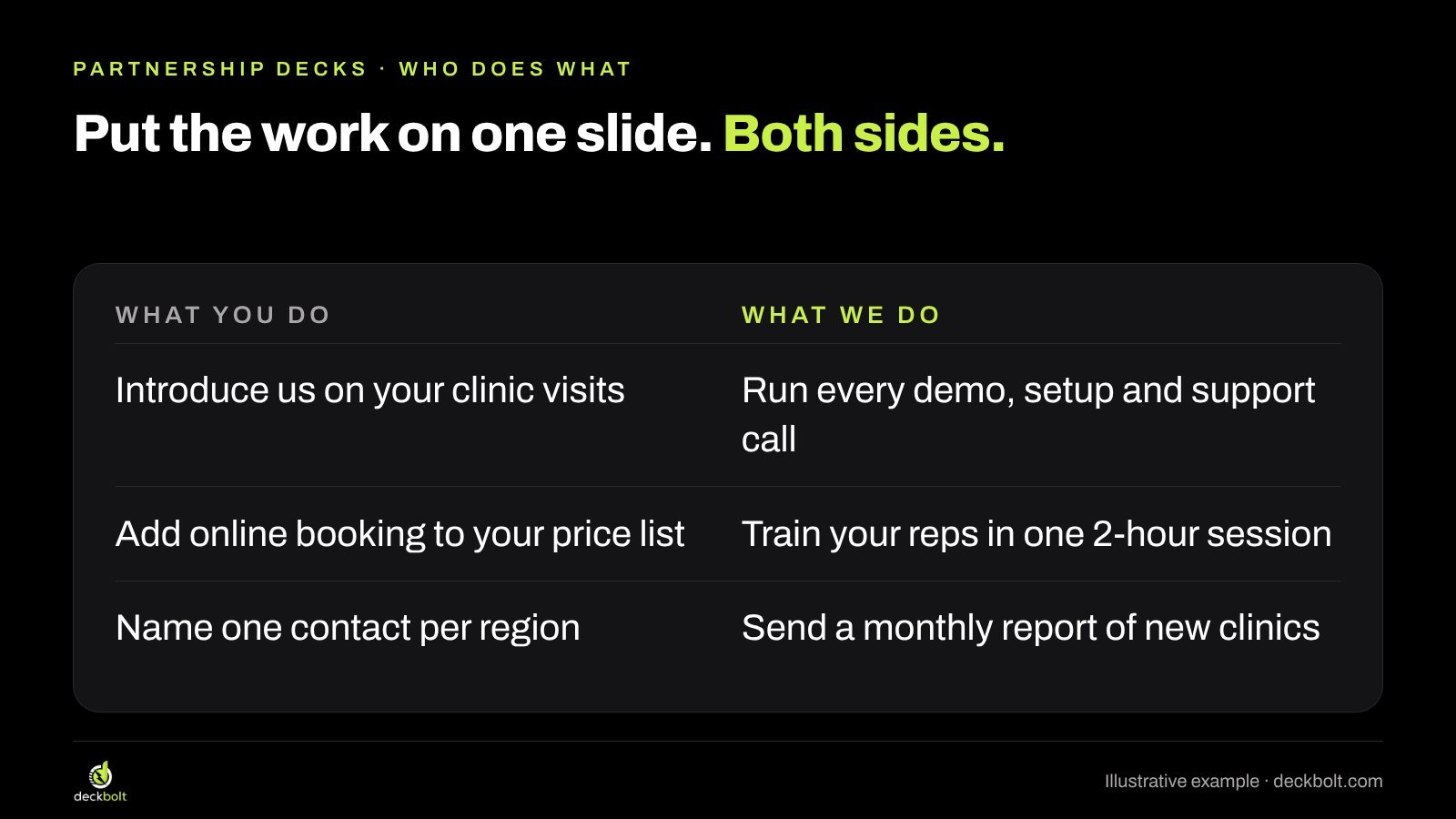
Partnerships often stall after a friendly meeting because nobody wrote down the work. “Let’s explore working together” is easy to agree to and hard to act on. Put the division of work on one slide, in two columns: what you ask them to do, and what you will do.
Be specific and honest about effort. “Introduce us on your clinic visits” and “name one contact per region” are clear asks. “Full enablement support” is not. If you need two hours of their reps’ time for training, say two hours. A small, named effort is far easier for your contact to approve internally than a vague one.
Move 4: Show how both sides win, in plain numbers
Partners tend to worry about three things before they sign: money, customers and data. Give each its own clear line rather than leaving them for the contract.
- Money. Who pays whom, how much, and for how long. A simple flow works well: the end customer pays a monthly fee, the partner keeps a share for a set period, you keep the rest and do the support.
- Customers. Who owns the relationship. Most partners want to know that their customer stays their customer, and that you won’t sell around them.
- Data. What gets shared and what doesn’t. Say which reports they will see, and what stays private.
If the terms aren’t settled yet, show your proposal and say it is a starting point. A clear proposal gives them something to react to; a blank gives them homework.
Move 5: Ask for a small pilot, not the whole deal
A company-wide partnership needs many approvals. A small pilot often needs one. End the deck with the smallest useful first step: a limited pilot with one goal, one date and one way to measure it.
For example: train ten reps in two regions in week one, let them introduce you on visits for the next eleven weeks, and review together on day 90. Agree the goal up front, such as 25 paying clinics live by 31 March, and agree what happens if you hit it: a rollout to every region. That last line matters. It tells your contact what they are really approving and gives the pilot a reason to exist.

A worked example, before and after
The example in this guide is illustrative: the companies, numbers and terms are made up to show the method.
Picture a small company that makes online booking software for independent physiotherapy clinics. It wants to partner with a regional distributor that sells treatment tables and equipment to clinics.
Before. The deck opens with a slide titled “Company Overview”: founded in 2021, a large and growing market, 140 clinics, 12 people, “seeking strategic partners”. It continues with the product, the roadmap and the team, and ends with “Let’s partner!”. Every slide is true. None of them mentions the distributor, its reps or its customers.
After. The deck opens with the distributor’s goal: “Give your reps a new reason to visit 1,200 clinics. Start with a 90-day pilot in 2 regions.” The next slides follow the five moves. Build, buy or partner, side by side. A two-column slide of who does what. One slide for money, customers and data: the clinic pays $79 a month, the distributor keeps 20% for two years, clinics stay the distributor’s customers for equipment, and patient data stays with the clinic. A pilot slide with one goal, one date and one measure. The company overview moves to the back, as one slide.
Nothing about the company changed. The deck simply answers the partner’s questions in the order the partner asks them.
Common mistakes in partnership decks
- Reusing the fundraising deck. Valuation, the round and use of funds have no place in a partnership pitch, and they can make the partner wonder whether you will be around next year.
- Leading with your logo wall. Customer logos are proof. They belong after you have shown what the partner gets, as support for your claims.
- Vague asks. “Strategic collaboration” and “co-marketing opportunities” give your contact nothing to approve. Name the action, the owner and the date.
- Hiding the money. If the revenue split only appears in the contract, the partner will assume it is bad. Put it on a slide.
- Asking for too much, too soon. An exclusive, national deal in the first meeting is a big decision for them. A pilot is a small one.
- Forgetting the forward. Your contact will often forward the deck to a boss who wasn’t in the meeting. If the deck only makes sense with you talking over it, it won’t survive that trip.
Building it in PowerPoint or Google Slides
A partnership deck is usually a send-ahead deck as well as a meeting deck, so build it to be read without you.
- Write the titles first. In PowerPoint, use View → Outline View; in Google Slides, type every title before you design any slide. Read the titles in order. They should tell the whole story on their own.
- Put the partner’s name on the cover and in the titles. “For [Partner name]” on the cover is a small signal that this deck was made for them.
- Use a two-column layout for “who does what”. A simple table with a header row and three to five rows reads faster than two bullet lists.
- Keep the appendix. Product detail, technical integration notes and your company history can sit after the closing slide, ready for questions.
- Send a PDF. It looks the same on every device, and nobody can accidentally edit your terms.
If you want more on writing slide titles that carry the argument, see our guide to answer-first executive presentations. For decks that will be forwarded, the send-ahead deck guide covers what gets lost when you are not in the room, and the send-ready checklist covers the final checks.

Checklist: five questions before you hit send
- Does slide 2 say what they get, in their words?
- Can they see why partnering beats building it or buying it?
- Does every ask say who does it, and by when?
- Are the money, the customers and the data each on one clear slide?
- Does the deck end with one small first step and a date?
Then run the forward test: could your contact forward slide 2 to their boss and get a yes to a first call? If not, rewrite slide 2 before you touch the design.
Get a partnership deck that answers their question first
At DeckBolt we design partnership, pitch and sales decks in PowerPoint and Google Slides, with 475+ projects across 22 countries. If you have a partner meeting coming up, send us your current deck and we’ll tell you what to change. Request a free deck review.