
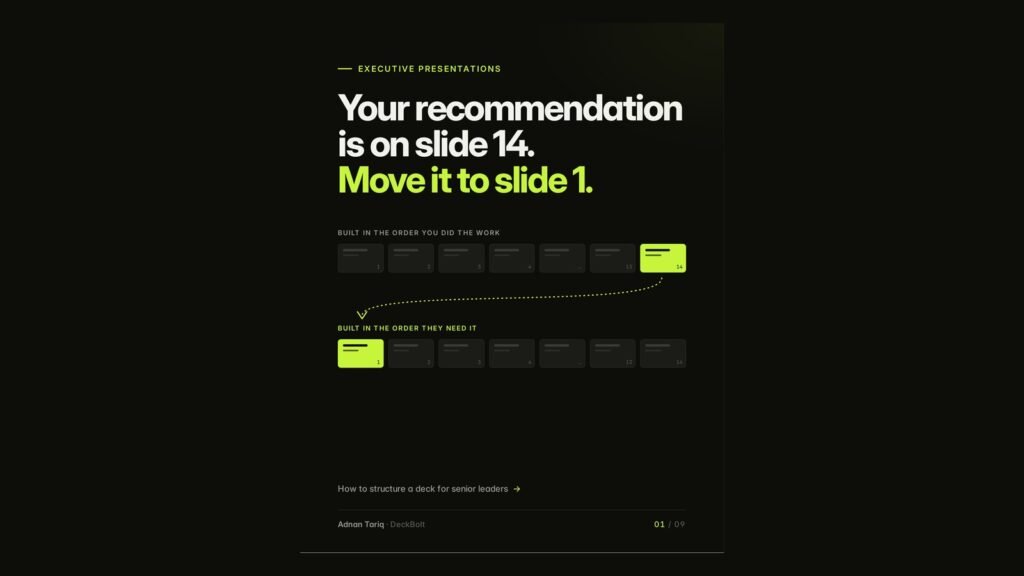
Most executive presentations are built in the order the work was done: background, approach, data, findings, and finally, on slide 14, the answer. It feels logical because that is how you got there. It is the wrong order for the people who need to decide.
The habit: the analyst’s order
- The analyst’s order: Background → Approach → Data → Findings → Answer
- The reader’s order: Answer → Reasons → Proof → Ask
The first is the right order for doing the analysis. The second is the right order for presenting it to people who need to make a decision.
Why it matters: senior meetings rarely go to plan
Leaders skim ahead, get pulled into another call, or lose ten minutes to the previous agenda item. With a build-up deck, a meeting cut short ends with no decision, because the answer was still four slides away. With an answer-first deck, a meeting cut short still ends with a decision.
Build for the meeting that gets cut short.
The structure: answer, reasons, proof, ask
Map the deck before you design it. In the example, the answer is “Consolidate to one vendor”. It rests on three reasons (lower total cost, one contract, faster support), each backed by proof (a cost comparison, a contract audit, a support log review). Everything ends in one ask: approve the switch by Friday.
Every slide after slide 1 should support one box on this map. If it does not, it belongs in the appendix.
Slide 1: open with the decision, not the agenda
- The headline is the recommendation: “Consolidate to one vendor by Q2”.
- Three reasons, one line each: lower total cost, one contract, faster support.
- The ask, with a deadline: “Decision needed today: approve the switch”.
If this is the only slide they see, they can still decide. (Our guide to the executive summary slide goes deeper on writing this one page.)
Move the method to the appendix
The main deck carries the answer and ask, each reason with its proof, and the risks and next steps. The appendix holds the methodology, assumptions, detailed tables, raw data and options considered.
Keep the work. Just do not make them sit through it. It is ready the moment someone asks.
Make the ask impossible to miss
Be explicit about what you need:
- Decision needed: approve the vendor switch
- Options: A, stay as is; B, switch; C, pilot first
- We recommend: option B
- By when: Friday
A decision, a budget, an approval or input: say which one, and by when. Otherwise the meeting ends with “let’s discuss”.
Before you present: the one-slide test
- Could they make the decision from slide 1 alone?
- Does every later slide support a reason on slide 1?
- Is the ask specific, with a deadline?
- Could the method live in the appendix?
Any “no”? Restructure before you redesign. Better slides cannot fix the wrong order.
Presenting to leadership soon? Send us the deck for a free deck review. We will review the structure and show you where the answer should go. No cost, no obligation.