
When you raise money, you build a deck. When you hire someone senior, most startups send a careers page: a mission statement, a list of values, a team photo and a line about perks. It looks friendly. It also leaves out almost everything a strong candidate is trying to decide.
Think about what a senior hire is doing. They are leaving a job that works to bet several years of their career on your company. That is an investment decision, just paid in time instead of money. And like an investor, they want to know whether the company will last, what they would own, who they would work with and what could go wrong.
This guide is for founders and hiring managers who pitch key hires: a first head of sales, a VP of engineering, a senior designer or operator. It covers what to put in a recruiting deck, how to say the uncomfortable parts, and how to keep it to a handful of slides.
Why the usual recruiting deck falls short
Most recruiting decks are written for a crowd. They try to make the company sound exciting to anyone who might apply. That is useful at the top of the funnel, but it fails at the moment that matters most: when one specific person is deciding whether to say yes.
By then, the candidate has already read your website. They don’t need the mission again. They need answers to their own questions, and if your deck doesn’t give them, they will ask in the interview, ask your investors, ask former employees, or quietly decide not to take the risk.

The list is shorter than you might think. Five questions cover most of it:
- Will this company last long enough for my bet to pay off?
- What would I actually own in my first months?
- Who would I work with, and who decides what?
- What is the hard part nobody has mentioned yet?
- What does the offer mean in practice?
Build the deck around those five questions and everything else gets easier. Keep the mission, values and perks to one slide at the start, then spend the rest of the deck on what the candidate is deciding.
Move 1: say how long the money lasts
This is the slide many founders skip, and it is often the question a strong candidate cares about most. They are not asking for your bank statement. They want to know whether the company can support the work they are signing up for.
A single sentence usually does it: how many months of runway you have, and when you plan to raise again. If revenue matters to the story, add where it stands today. If the plan depends on a raise, say what changes if it slips.
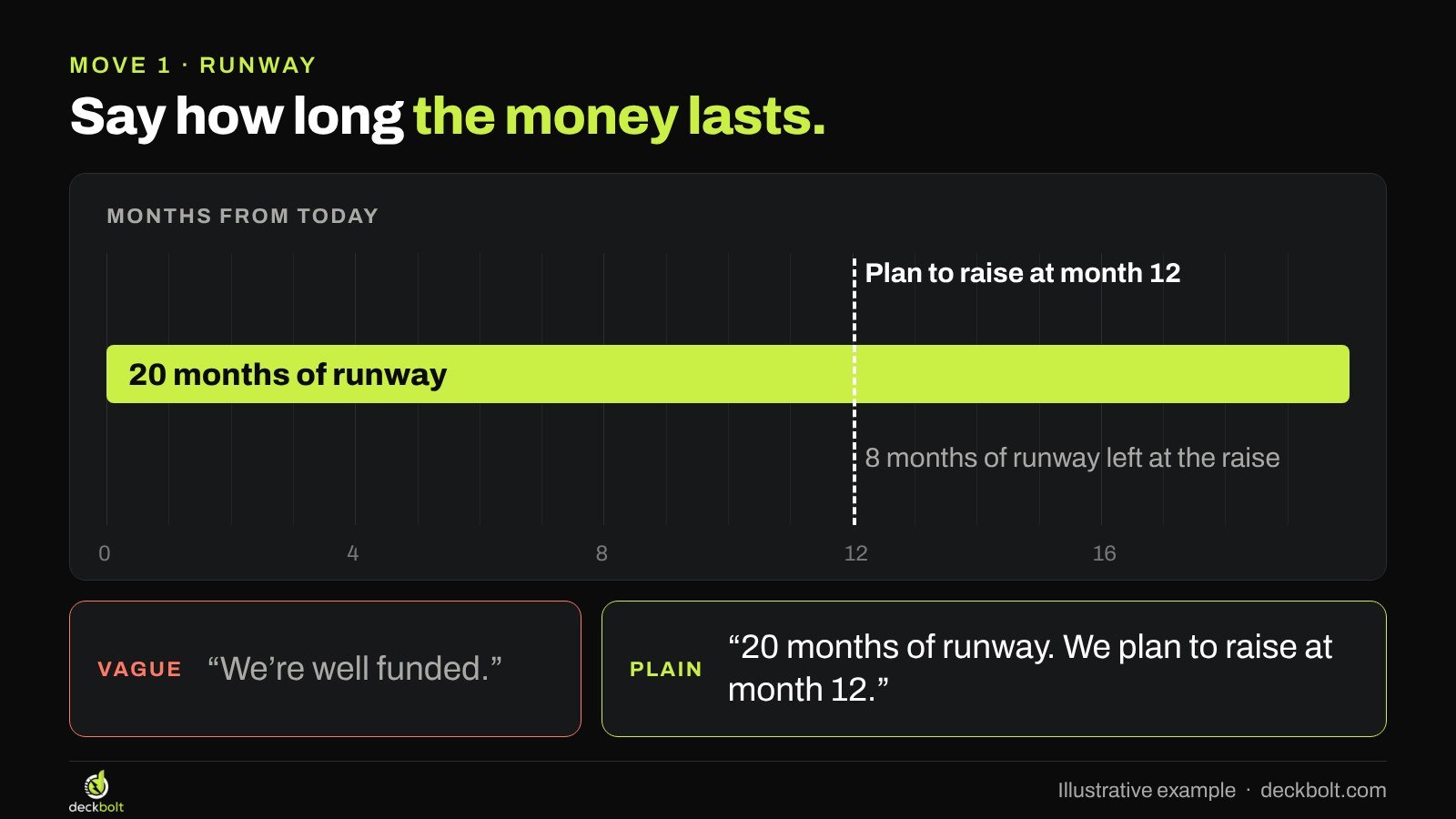
What doesn’t work is vague comfort. “We’re well funded” answers nothing, and an experienced candidate will hear it as a reason to dig. A plain number, said first, builds more trust than a confident phrase.
If you prefer not to put exact figures in a file that can be forwarded, keep the slide simple and say the numbers in the conversation. Our guide to what can leak from an editable deck is worth a read before you send anything outside the company.
Move 2: show the first 90 days, not a job description
A job description lists duties. A candidate can’t picture themselves in a list of duties. They can picture a plan.
Lay out the first 90 days in three steps: what they would learn, what they would build and what they would own by the end. Keep each step concrete enough to check. “Meet the 20 biggest customers” is concrete. “Drive customer success excellence” is not.
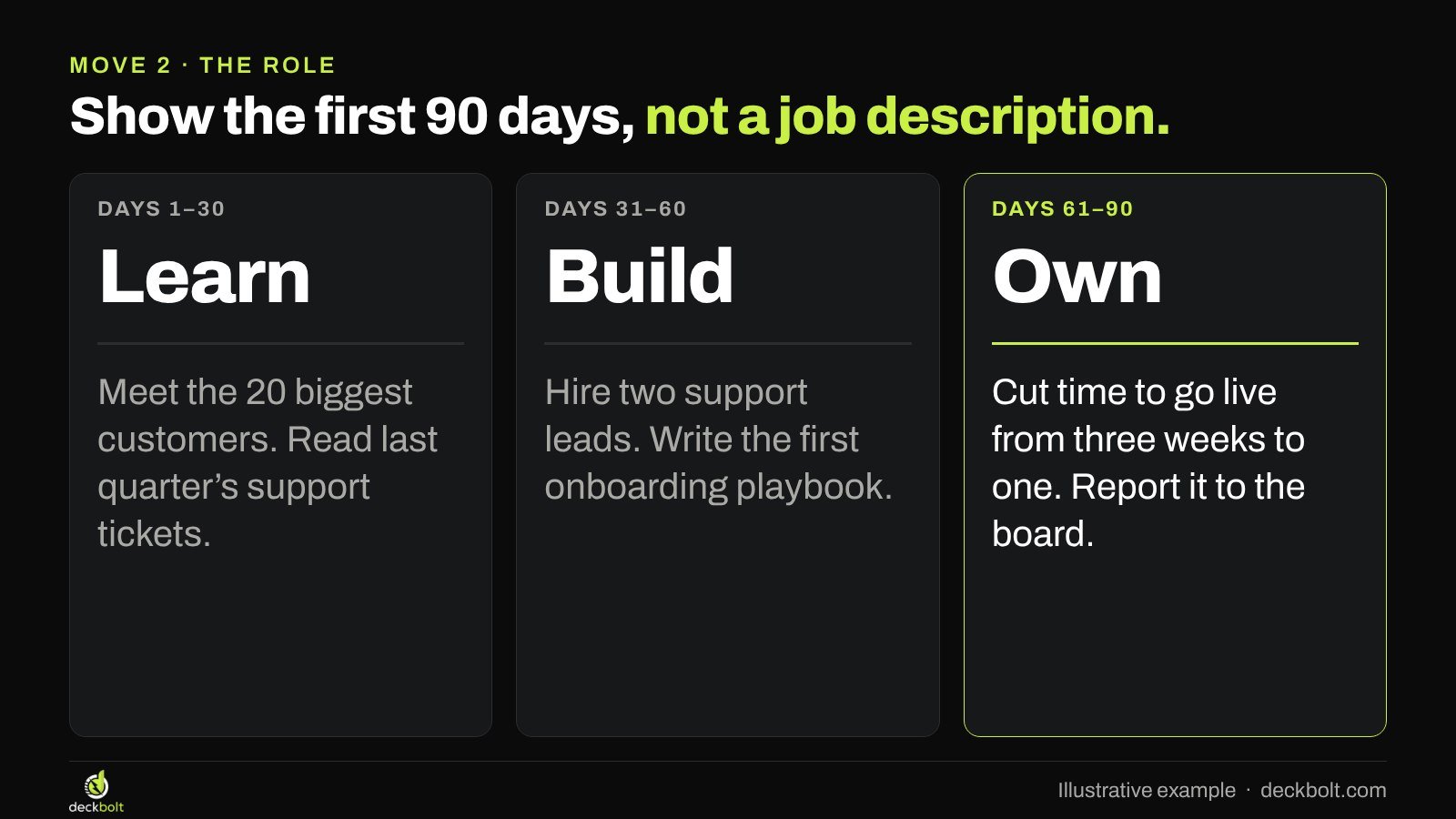
Here is an illustrative example for a first head of customer success at a software startup:
- Days 1–30, learn: meet the 20 biggest customers and read every support ticket from last quarter.
- Days 31–60, build: hire two support leads and write the first onboarding playbook.
- Days 61–90, own: cut the time it takes a new customer to go live from three weeks to one, and report it to the board.
This slide does two jobs. It shows the candidate what success looks like, and it forces you to agree internally on what the role is for. If you can’t fill in the 90 days, the role probably isn’t ready to hire for.
Move 3: show who they’d work with, and who decides what
Senior people rarely leave jobs because of the work itself. More often it’s the people, or the feeling that they don’t have the authority to do what they were hired to do. Answer both on one slide.
Show the three or four people the candidate would work with most: who they report to, their closest partner, and the team they’d lead. One line each is enough, written as how they’d work together, not as a résumé.
Then say how decisions get made. For example: “You decide how the support team works. Spending over $10K goes to the CEO.” It’s a small sentence that answers a big question. It also prevents the most common surprise in a senior hire’s first quarter.
Move 4: tell them the hard part
Every company has a hard part. The candidate will find it in month two whether you mention it or not. If they hear it from you first, it becomes a challenge they chose. If they discover it, it becomes something you hid.
The trick is to replace stock phrases with specifics:
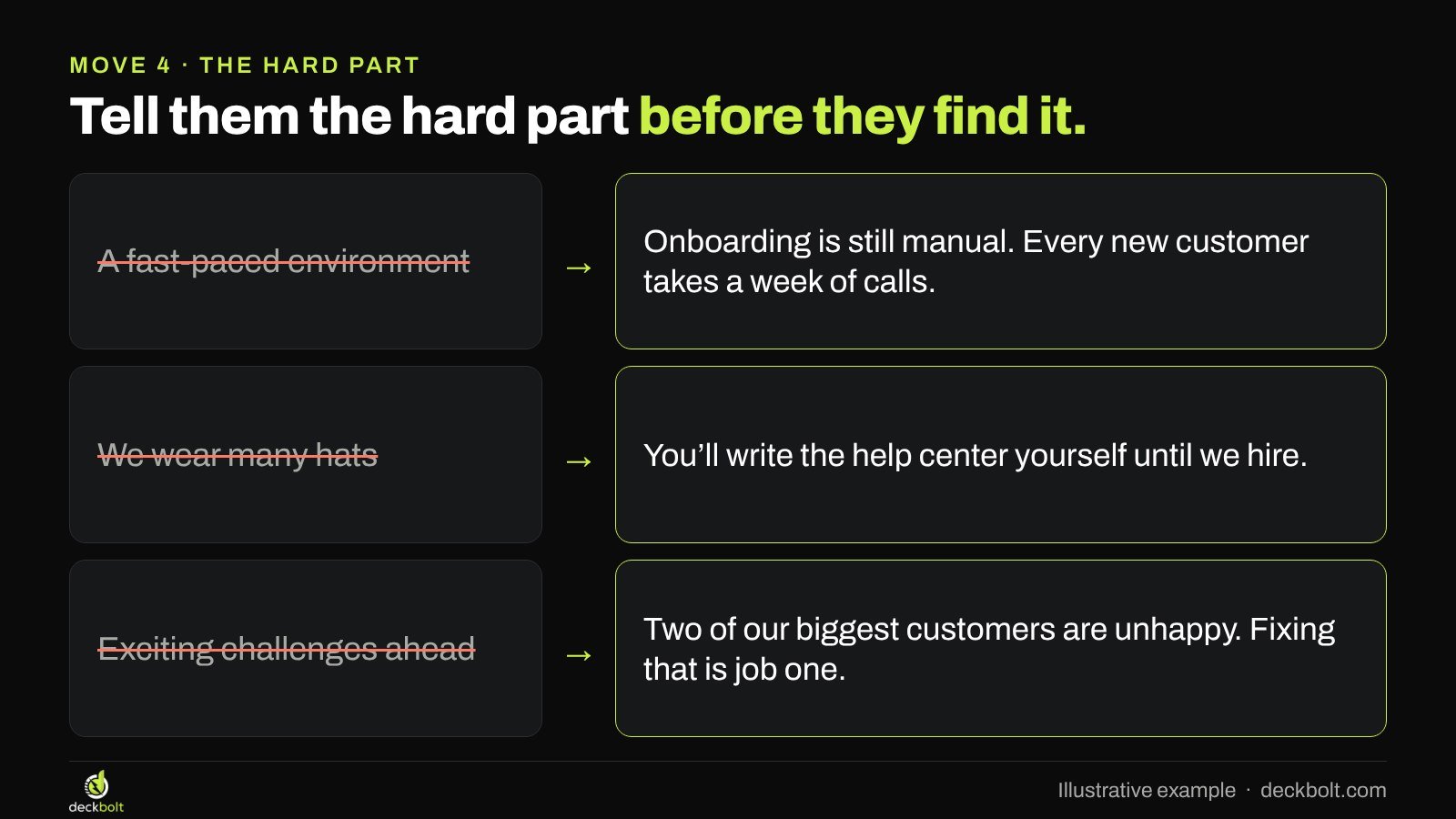
- “A fast-paced environment” becomes “Onboarding is still manual. Every new customer takes a week of calls.”
- “We wear many hats” becomes “You’ll write the help center yourself until we hire.”
- “Exciting challenges ahead” becomes “Two of our biggest customers are unhappy. Fixing that is job one.”
For the right person, a clear problem is attractive. It tells them exactly where they can make a difference. And it filters out people who would have struggled with it anyway, which saves both of you a painful year.
Move 5: explain the offer in plain words
Equity is often the part of an offer that candidates understand least, which also makes it the part they value least. A number they can’t interpret isn’t worth much to them.
Walk through it on one slide, in plain language: what the grant is, how it vests, what it could be worth and why that isn’t guaranteed, and what they should ask you. For example, an illustrative grant might read: 0.5% of the company as stock options, vesting over four years, with the first 25% after year one.
Be careful with projections. It’s fine to explain how the value depends on future rounds and an exit. It isn’t fine to promise an outcome. Have your lawyer check the wording of anything you put in writing, and invite the candidate to ask about the strike price, the latest valuation and what happens if they leave.
How to structure the deck
Put together, a recruiting deck for a senior hire can be as short as seven or eight slides:
- One slide on what the company does and why it matters.
- Where the company stands: customers, revenue if you share it, and runway.
- The role in one sentence, then the first 90 days.
- The people they’d work with and how decisions are made.
- The hard part, said plainly.
- The offer, explained.
- Next steps and who to talk to, including a customer or an investor if they’d like.
Use the same discipline you would use for investors: put the answer first on every slide, write titles as full sentences, and cut anything that doesn’t help this person decide. If a slide could go into a deck for any candidate, it probably belongs on the careers page instead.
When to send it, and how to use it
A recruiting deck works best at a specific point in the process: after the first conversation, once you both think the fit is real, and before the final interviews. Sent too early, it reads like marketing. Sent too late, the candidate has already formed their view from other sources.
Don’t just email it. Walk the candidate through it on a call, then send the file so they can read it again and share it with the people they’ll talk the decision over with. That second reading matters: a partner, a mentor or a former manager will often ask the toughest questions, and your deck should answer them without you in the room.
Keep one master version and adjust two slides per candidate: the first 90 days and the people they’d work with. Everything else stays the same, which keeps the story consistent when two candidates compare notes.
What to leave out
Some things weaken a recruiting deck even when they’re true. Long histories of how the company was founded belong in a conversation, not on a slide. Lists of perks rarely change a senior hire’s decision. Logos of customers you can’t talk about in detail invite questions you can’t answer. And anything you wouldn’t want forwarded to a competitor shouldn’t be in a file you send to someone who doesn’t work for you yet.
Common mistakes
- Reusing the investor deck. It answers some of the same questions, but not what the role is or who the candidate would work with.
- Selling only the upside. Senior candidates have seen enough decks to notice what’s missing.
- Vague runway language. “Well funded” invites the question you were trying to avoid.
- A job description in slide form. Duties are not a plan.
- Equity as a bare number. If they can’t explain it to their partner at home, it won’t carry weight.
A five-question check
Before you send the deck, ask whether a candidate could answer each of these after reading it:
- How long does the money last?
- What would I own in 90 days?
- Who would I work with?
- What’s the hard part?
- What does the offer mean?
If any answer is missing, that’s the slide to write next. The same approach works for any deck where one person has to make a big decision: start from the argument they need, not the design.
The examples, numbers and terms in this article are illustrative. This is not legal or financial advice; have a lawyer review any offer wording.
Pitching a senior hire, an investor or a board? DeckBolt designs pitch, sales and executive decks built around what your reader has to decide, in native PowerPoint and Google Slides. Request a free deck review.