

Most founders send their investors an update. Fewer send one that investors actually read to the end. The usual version is long, arrives weeks after the month closed, and reads like a diary: the offsite, the new office, the features that shipped. The revenue number sits somewhere in paragraph three. The ask, if there is one, is a line at the bottom that says “let us know if you can help.”
This guide is for founders and CEOs who send regular updates to angels, funds or a board, and who want those updates to do more work: keep investors close, surface problems early, and turn goodwill into specific help. It covers why updates drift into diaries, a five-block structure you can reuse every month, a worked example, the most common mistakes, and a checklist to run before you hit send.
Why most investor updates read like a diary
An update usually gets written the way the month felt. You start with what was on your mind, and the month you remember is full of events: hires, launches, meetings, a conference. Numbers feel cold, so they get tucked into a sentence. Problems feel risky, so they get softened or left out. The ask feels awkward, so it becomes a polite P.S.
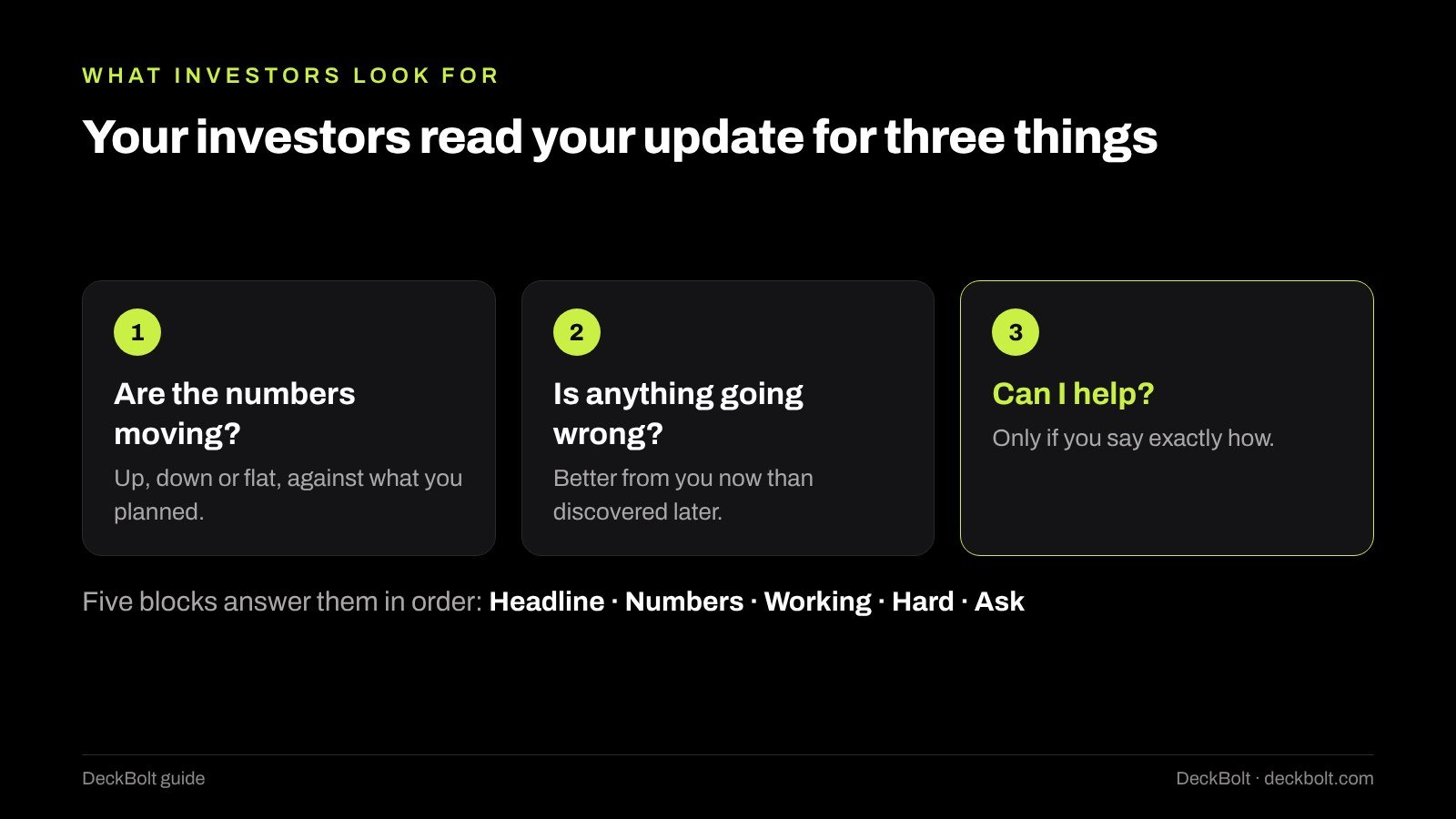
The result is accurate, friendly and hard to use. Your investors are not reading it to relive your month. Most of them follow many companies and read updates between other emails. When they open yours, they are looking for three things:
- Are the numbers moving? Up, down or flat, and against what you planned.
- Is anything going wrong? They would rather hear it from you now than discover it later.
- Can I help? And if so, exactly how.
A diary-style update makes them dig for the first, hides the second and leaves the third vague. That matters, because the people on that list are often the ones who could back your next round, introduce you to a customer or vouch for you when another investor calls. Every update is a small pitch, sent to people who already said yes once.
The five-block structure
A good update is short enough to read in about two minutes and built the same way every month, so readers know where to look. Five blocks, always in this order:
- Headline. The month in one line, good or bad.
- Numbers. The same four to six metrics, each shown against plan and against last month.
- What’s working. Two or three short lines, each with evidence.
- What’s hard. What isn’t working, said plainly, and what you’re doing about it.
- The ask. One or two specific ways an investor could help this month.
The order is the point. It mirrors the three questions above: how did it go, what’s going wrong, how can I help. It also means a reader who stops after the first line still leaves with the right picture, and one who reads to the end knows exactly what to do next. This is the same answer-first idea that works in executive presentations: lead with the conclusion, then show the support.
Block 1: open with the news, even when it’s bad
The headline is the line most people will read, so it has to carry the month. “Busy month! Lots of progress across the board.” tells the reader nothing. Compare it with: “Revenue came in 10% under plan. Two deals slipped to December, and our pipeline is the biggest it’s been.”
The second version is less cheerful and far more useful. It states the result, gives the reason, and points at what comes next. A simple test: if an investor reads only this line and then gets pulled into a meeting, do they know how your month went? If not, rewrite it.
Don’t save bad news for paragraph four. Investors tend to notice when the headline is upbeat and the numbers below it aren’t. Putting the miss up front, with its reason, reads as being in control of the business.
Block 2: the same numbers, against plan, every time
A number on its own means very little. “$38K revenue” could be great or terrible. Put the plan and last month next to it and it becomes information: $38K against a $42K plan, up from $35K last month. Now the reader can see you grew, and that you’re behind where you expected to be.
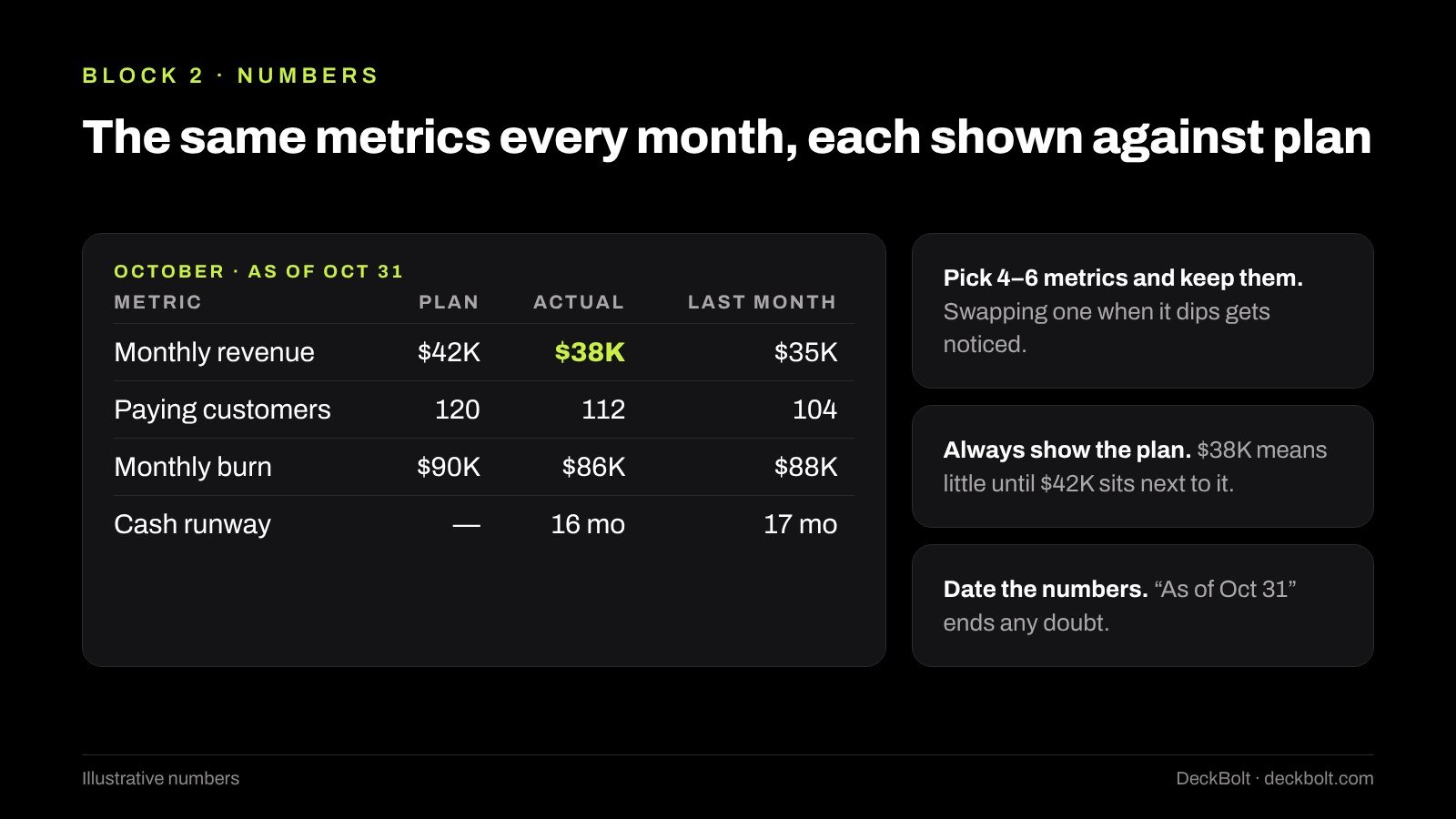
Three rules keep this block honest:
- Pick four to six metrics and keep them. Revenue, paying customers, burn and runway are a common core; add the one or two that matter most for your model. Swapping metrics when one of them dips is one of the first things readers notice.
- Always show the plan. If you don’t have a monthly plan, use the target you shared when you raised. Without a comparison, the reader has to guess.
- Date the numbers. “As of Oct 31” removes any doubt about which month you mean, and it keeps the update consistent with your deck and your model. If your numbers live in several places, the habits in our guide to cross-checking the numbers in a pitch deck apply here too.
A small table is usually clearer than sentences for this block. Four columns are enough: metric, plan, actual, last month. Highlight the one number your headline is about.
Block 3 and 4: what’s working and what’s hard
“What’s working” is where the good news goes, with evidence. Not “sales momentum is strong” but “pipeline is $410K, up from $260K in September.” Two or three lines are enough. If something is working, the number will show it.
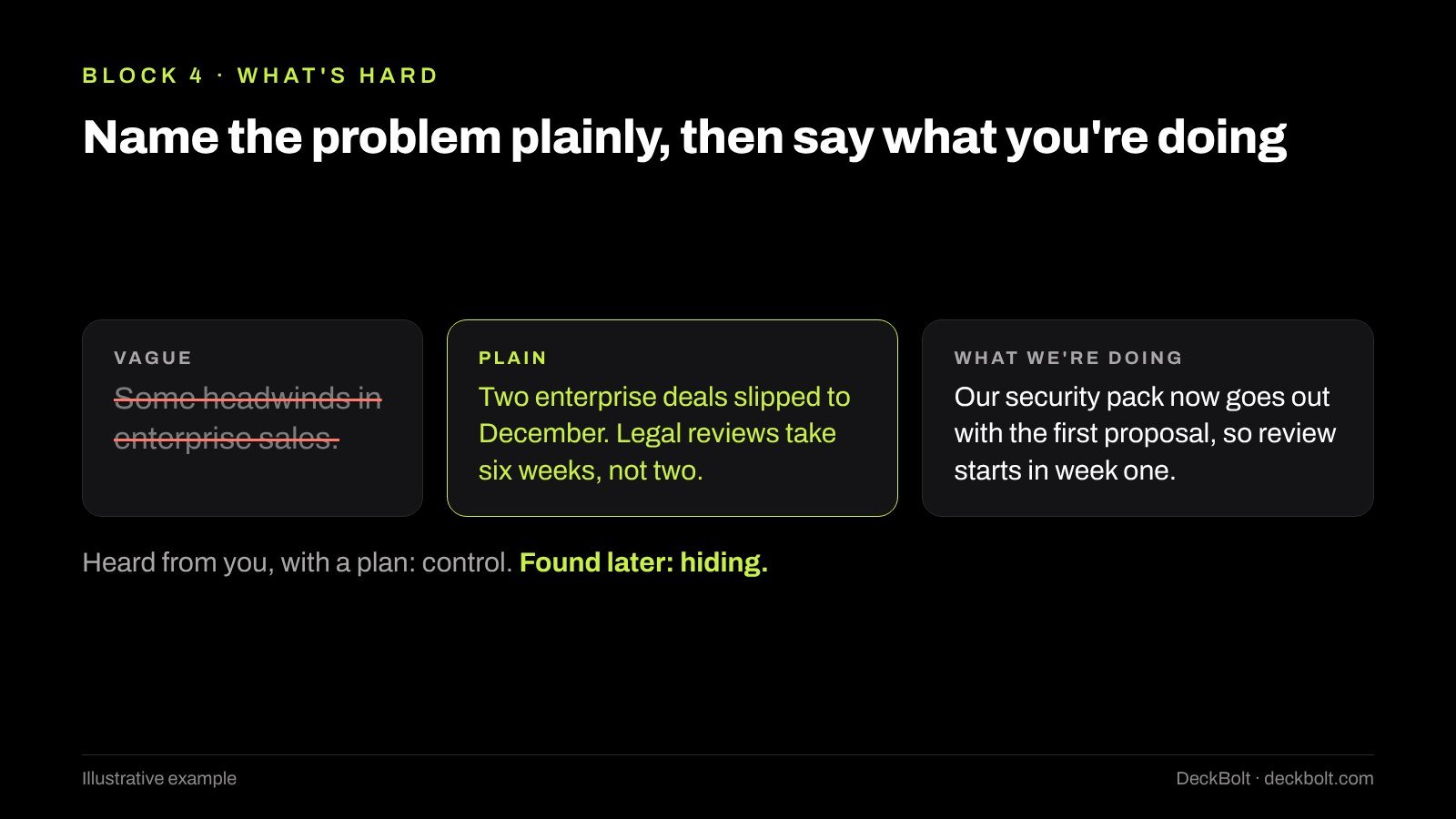
“What’s hard” is the block most founders leave out, and the one investors value most. Name the problem plainly, then say what you’re doing about it. Compare:
- Vague: “Some headwinds in enterprise sales.”
- Plain: “Two enterprise deals slipped to December. Their legal reviews take six weeks, not the two we planned for. We now send our security pack with the first proposal, so review starts in week one.”
The plain version tells the reader what happened, why, and what changed. A problem investors hear from you, with a plan attached, reads as control. The same problem discovered later, at a board meeting or in due diligence for your next round, reads as hiding. If you send a board deck as well, the same principle applies there; our guide to board meeting decks covers how to present bad news on a slide.
Block 5: one clear ask
“Let us know if you can help!” almost never gets a reply, because nobody can act on it. An investor reading it would have to work out what help you need, who might provide it and how to introduce you. Most won’t. A specific ask turns a vague wish into something one person can say yes to in a few seconds.
- Instead of “intros to potential customers”: “Heads of operations at 50–200 person logistics firms in Texas.”
- Instead of “help with hiring”: “A senior engineer who has built billing systems.”
- Instead of “any advice on pricing”: “20 minutes with someone who moved from per-seat to usage pricing.”
Keep it to one or two asks per update, so each one gets attention. Then make it easy to act on: add a three-line blurb about your company that an investor can paste straight into an intro email. And when someone does help, say so in the next update. People help more when they can see that help land.
A worked example: before and after
This example is illustrative: the company, numbers and names are made up.
The “before” version opens with “October update!”, spends three paragraphs on the offsite, two new engineers, a new office and a dark-mode release, mentions revenue of $38K “a little behind where we hoped”, promises “exciting things coming”, and ends with “P.S. Let us know if you can help!” It arrived on November 24.
The “after” version of the same month reads like this:
- Headline: October: revenue 10% under plan, pipeline at a high.
- Numbers (plan / actual / last month): Revenue $42K / $38K / $35K. Paying customers 120 / 112 / 104. Burn $90K / $86K / $88K. Runway 16 months.
- Working: Pipeline $410K, up from $260K in September.
- Hard: Two deals slipped: legal reviews take six weeks. Our security pack now goes out in week one.
- Ask: Intros to heads of operations at 50–200 person logistics firms in Texas. Blurb below.
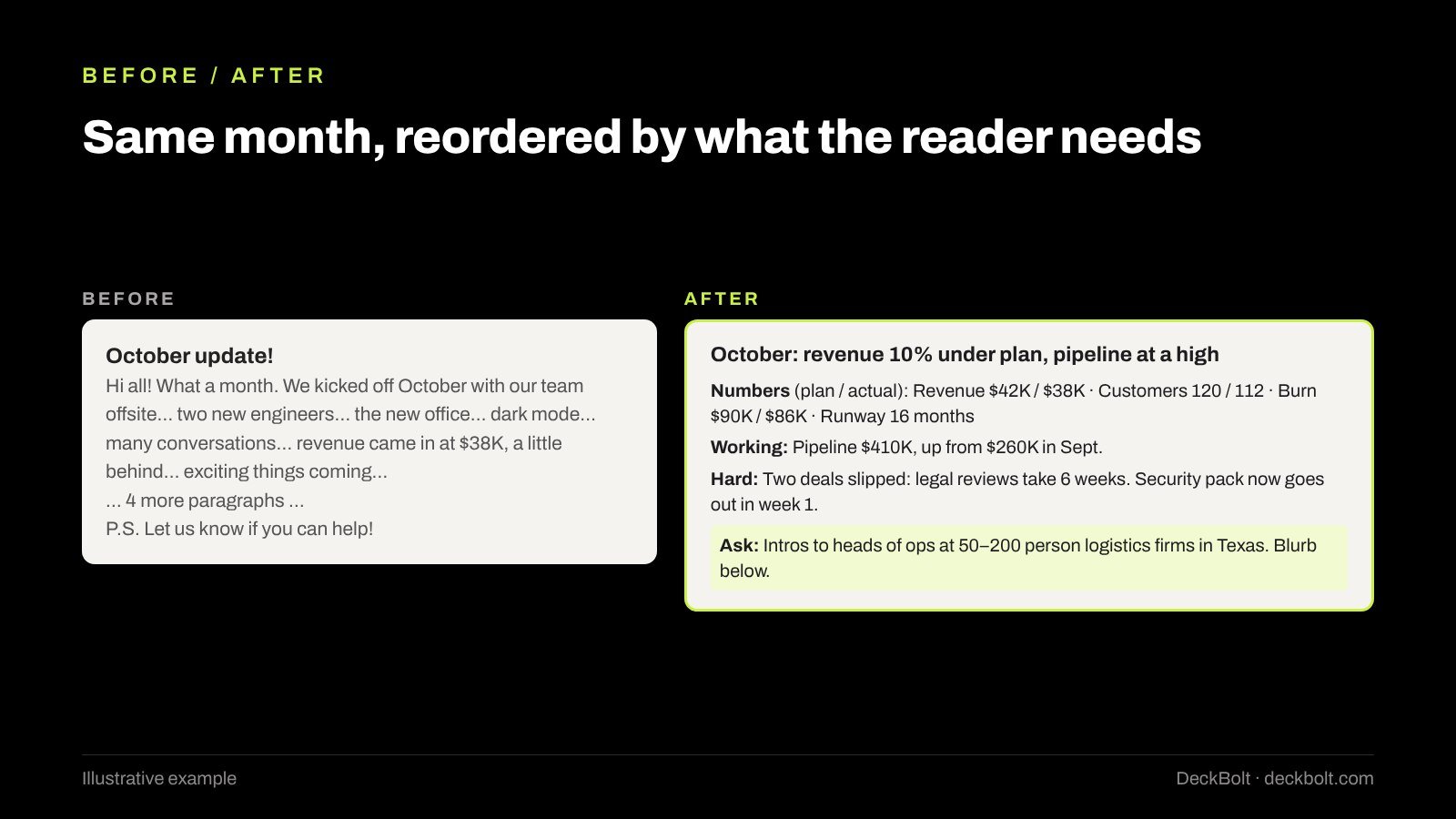
Nothing in the “after” version is hidden or spun. It is simply ordered by what the reader needs. It also went out on November 5, within a week of month end, which on its own signals a team that has its numbers under control.
Common mistakes to avoid
- Sending late. An October update in late November is old news. Pick a day, such as the fifth working day of the month, and keep it.
- Changing the metrics. Readers compare month to month. If a metric changes, say why once, then keep the new one.
- Only good news. A run of all-positive updates makes the first bad one look like a surprise. A steady “what’s hard” block makes problems normal and manageable.
- Too long. If it takes more than two or three minutes to read, move detail to an attachment or a link.
- A deck instead of an update. A monthly update rarely needs slides. A short email, with one table, usually works better. Save a fuller deck for quarterly or board updates.
- An ask nobody can act on. If the ask doesn’t name a role, an industry or a kind of person, it is too vague.
Making it easy to write every month
The structure only works if you keep it. A few habits help:
- Use a template. Keep the five headings and the metrics table in a saved draft. Each month you fill in the blanks instead of starting from scratch.
- Keep one numbers sheet. Pull the update’s figures from the same sheet that feeds your model and deck, so they always agree.
- Collect the month as it happens. A running note of wins, problems and possible asks makes the update a 30-minute job, not an evening.
- Quarterly, add slides. Every third update, it can help to attach a short deck with a few charts showing the trend over the quarter. Keep the same order: headline, numbers, working, hard, ask.
When the time comes to raise again, these updates become a record of how you run the company. Investors who have read a year of clear, honest updates come into the next conversation already knowing your numbers. That makes the first meeting about the plan, not the basics, which is also what the second investor meeting is about.
Checklist: before you hit send
- Does the first line tell them how the month went?
- Are the numbers the same ones as last month?
- Is every number shown against plan?
- Did you name what’s hard, and what you’re doing about it?
- Is there one ask someone could act on today?
- Did it go out within a week of month end?
Same order, same numbers, same day each month. Then a flat month doesn’t look like you’re hiding something, and a good month speaks for itself.
Note: the examples, companies and numbers in this article are illustrative.
Raising your next round soon? Your updates keep investors close; your deck makes the case when it’s time to raise. DeckBolt designs pitch decks and investor presentations in PowerPoint and Google Slides. Request a free deck review.