

Many founders and business owners prepare one deck and send it to everyone. The investor pitch is already designed, it tells a strong story, and it took weeks to get right. So when the business needs a bank loan or an equipment finance facility, the same deck goes to the lender.
It usually lands badly. Not because the business is weak, but because the deck answers a question the lender isn’t asking. An investor is betting on how big the business could become. A lender is asking something much narrower: will this loan come back, on time, even if things go slower than planned?
This guide is for founders, owners and finance leads who are preparing a presentation for a bank, a credit union, a lender’s credit team or a debt fund. It covers what changes when the reader is a lender, five moves that make a loan deck easier to approve, a worked example, common mistakes, and a checklist you can use before you send it.
Note: this is presentation advice, not financial or lending advice. Every lender has its own criteria, ratios and forms. Ask yours what they need, and use this guide to present it clearly.
Why an investor pitch doesn’t work for a lender
An equity investor and a lender look at the same business from opposite ends. The investor owns a share of the upside. If the company grows ten times, they win big, so the deck is built to show how big it could get: market size, vision, a steep growth curve, the team that will make it happen.
A lender doesn’t share in that upside. Their best outcome is getting their money back with interest, on schedule. So what they look for is the downside. Where does the money to repay come from? How much room is there if trading gets harder? What happens if the plan slips? What can they rely on if things go wrong?

Put those two readers side by side and the gap is clear. Market size matters less than the cash the business makes today. The growth curve matters less than the cash left over after every repayment. A best case matters less than a believable slower case. And instead of the share of the company on offer, the lender wants to know what backs the loan.
None of this means the vision has to go. It means the vision moves. In a loan deck it comes after the numbers a lender reads first, as the reason the business will keep getting stronger over the term of the loan.
Move 1: Put the ask in one line on page one
Investor decks often save the ask for the end, after the story has built up to it. A lender wants it at the start, because everything else in the deck is evidence for or against that one request.
A heading like “Growth Capital Opportunity” tells a credit team nothing. Write the request as a sentence that answers four questions at once:
“[Amount] over [term] to [specific use], repaid from [source].”
For example: “We’re asking for $250K over 5 years to add a second production line, repaid from current bakery sales.” In one line, the reader knows the size of the loan, how long they’ll be exposed, what the money buys and where repayments come from. The rest of the deck can now be read as support for that sentence.
If the money has more than one use, add a short breakdown right under the ask: equipment, fit-out, working capital, each with an amount. Keep it to a few lines. A lender should be able to see that the pieces add up to the total without opening a spreadsheet.
Move 2: Show where the repayments come from
This is the slide a lender looks for first, and the one many decks don’t have. Instead of a revenue forecast, show the cash the business already generates from its operations, month by month, and put the new loan payment on the same chart.

In the illustrative example, a two-shop bakery generates between about $9.6K and $12.4K a month from operations. The new loan, $250K over 5 years at 6%, would cost about $4.8K a month. Drawn as a dashed line across the bars, the payment sits well below every month. The reader can see the margin in seconds.
A few details make this slide stronger:
- Use actual months, not a forecast. Last 12 months of real results carry far more weight than next year’s plan.
- Include the weak months. If trading is seasonal, the lowest month is the one the lender will care about. Show it rather than averaging it away.
- Say what “cash from operations” includes. A short footnote that matches the figure to your accounts saves a round of questions.
- Show existing debt payments too. If you already repay other loans or leases, the chart should show the total of old and new payments, not just the new one.
Move 3: Show how much room you have as one number
Once the reader has seen the cash and the payments, give them a single number for the margin between the two. Lenders often call this debt service cover: cash available to repay debt, divided by the debt payments due over the same period.
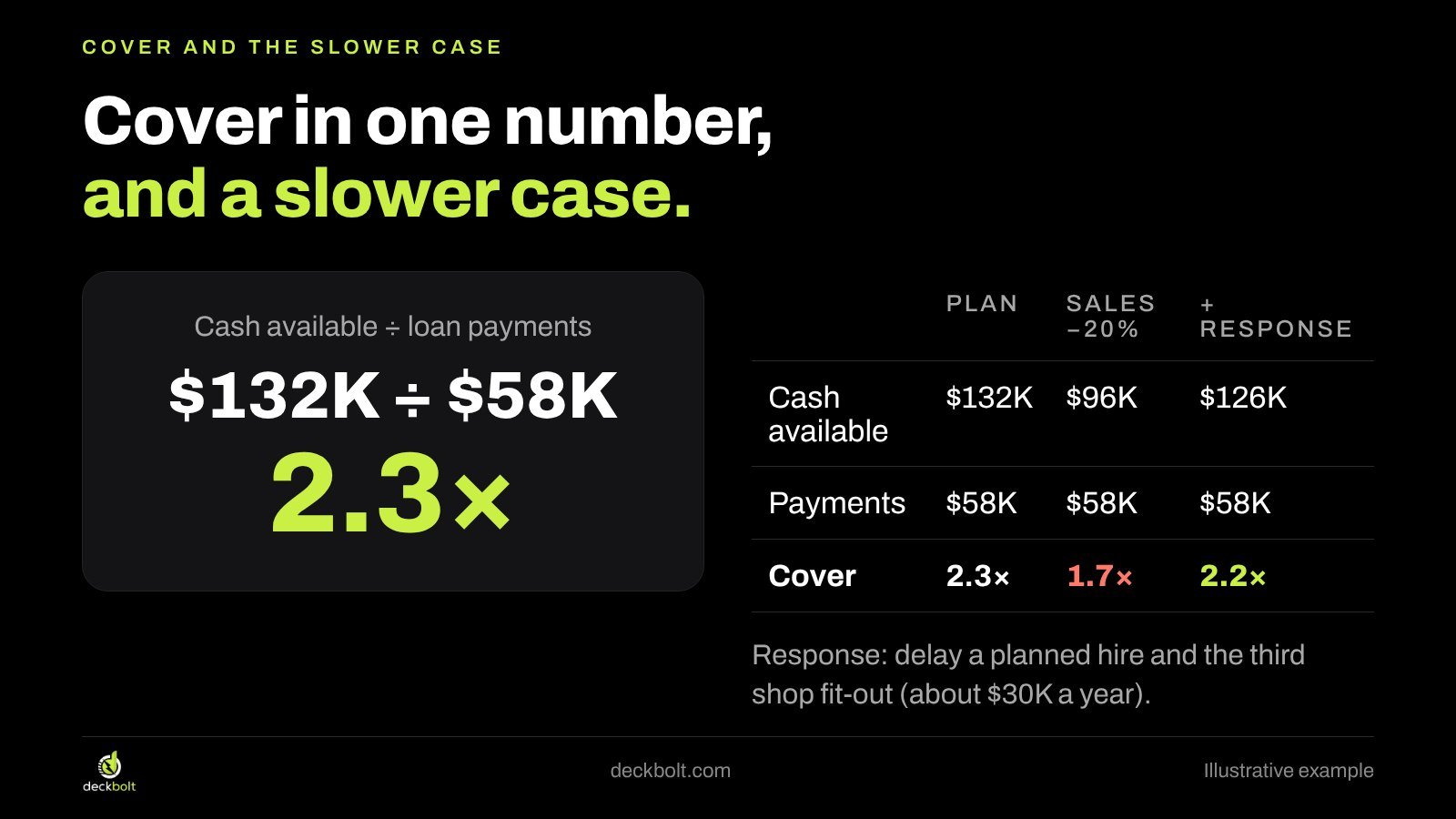
In the example, the bakery has about $132K a year available against $58K a year of loan payments, a cover of about 2.3×. That one figure tells a credit team how far trading could fall before repayments are at risk.
Two cautions. First, lenders define cover in different ways, and many have a minimum they want to see. Ask yours which version they use and present it the same way, with the same inputs. Second, show the calculation, not just the result. A ratio on its own invites the question “based on what?”. Two numbers and a division sign answer it before it’s asked.
Move 4: Show a slower case and your response
Investor decks tend to show the best case. A lender assumes something will go wrong over a five-year term, so a deck that only shows the plan looks either naive or evasive. Show what happens if sales dip, and what you would do about it.
Keep it simple. A three-column table works well: the plan, a slower case, and the slower case with your response. In the illustrative example, if sales fell 20%, cash available would drop from $132K to about $96K a year and cover would fall from 2.3× to about 1.7×. The response, delaying a planned hire and a third shop fit-out, saves about $30K a year and brings cover back to about 2.2×.
The slower case doesn’t need to be dramatic. It needs to be believable and specific. Name the action, name what it saves, and say when you would take it. “We’d cut costs” is a promise. “We’d delay the third shop fit-out, which saves about $30K a year” is a plan.
Move 5: State what backs the loan, plainly
A lender will find out what you already owe, what assets exist and how long you’ve been trading. Telling them first, clearly, builds more trust than waiting for the questions. One slide with four short items usually covers it:
- The asset the loan buys. What it is, what it cost and how long it is expected to last.
- Your track record. Years trading, accounts filed and any past loans repaid.
- What you already owe. Every existing loan and lease, one line each, with the monthly payment.
- Any guarantee you’ve agreed to. Only what is actually on the table. Don’t offer security in a deck that you haven’t discussed with your advisers.
This is also the right place for anything unusual: a one-off loss, a change of ownership, a large customer you depend on. A short, honest line is better than a credit analyst discovering it in the accounts.
Before and after: reordering an investor deck for a lender
You rarely need to start from scratch. Most of the facts in an investor deck are still useful to a lender. What changes is the order, and a few slides that need to be added.

A typical investor deck runs: vision, problem, market, product, traction, team, financials, the ask. For a lender, the same material reads better as: the ask, the business today, where repayments come from, cover, the slower case, what backs the loan, the team and track record, and finally where the business is going. The vision is still there. It’s just the last thing the lender reads instead of the first.
When you rework the deck, rewrite the slide titles too. “Financials” becomes “Cash from operations already covers the new payment more than twice.” “Team” becomes “The same management team has run the business for six years.” Titles that state the point are especially useful in a credit team, where your deck may be summarised by someone who never met you.
Common mistakes in loan presentations
- Leading with the market. A large addressable market says little about whether a specific loan will be repaid.
- Showing revenue instead of cash. A lender is repaid from cash, after costs. Profit and revenue charts don’t answer the question on their own.
- Hiding existing debt. It will come out in the credit checks. Leaving it out of the deck makes everything else look less reliable.
- A slower case with no response. Showing the risk without the plan only does half the job.
- Too many slides. A credit team reads many applications. Keep the main deck short and put detailed statements and forecasts in an appendix or a separate pack.
- Numbers that don’t match the accounts. If a figure on a slide can’t be traced to the financial statements you’ve provided, add a note that explains the difference.
Building it in PowerPoint or Google Slides
The repayment chart in Move 2 is a standard column chart with one extra series. In PowerPoint, insert a clustered column chart, add the monthly loan payment as a second series, then go to Chart Design → Change Chart Type → Combo and set that series to Line. Format it as a dashed line in your accent color and label it directly instead of using a legend. In Google Slides, build the same combo chart in Google Sheets and insert it with Insert → Chart → From Sheets, so it stays linked to your numbers.
For the cover and slower-case slides, a simple table is usually clearer than a chart. Keep the same row order on every slide, align the numbers to the right, and highlight only the one figure the slide is about.
Checklist: five questions before you send a loan deck
- Is the amount, use and term on page one, in a single sentence?
- Can the reader see where every repayment comes from, using real months?
- Is cover shown as one number, with the calculation next to it?
- Is there a slower case, with a specific response and what it saves?
- Is everything you already owe on the page?
Then try the banker test: could your banker present page one to their credit team without calling you to explain it? If yes, the deck is doing its job.
For related reading, see how to write the ask slide in an investor deck, how to show the assumptions behind your financial projections, and how to build a budget request that wins against competing priorities.
All company details and numbers in this article are illustrative examples, not real clients or lending terms.
Preparing a presentation for a lender, an investor or your board? DeckBolt designs presentations that answer the reader’s real question first. Request a free deck review.