
The ask slide in many pitch decks is a pie chart: 40% engineering, 30% sales and marketing, 20% operations, 10% other. It shows where the money goes. It does not show what the money gets you, and that is what investors are actually buying.
An ask slide built on milestones
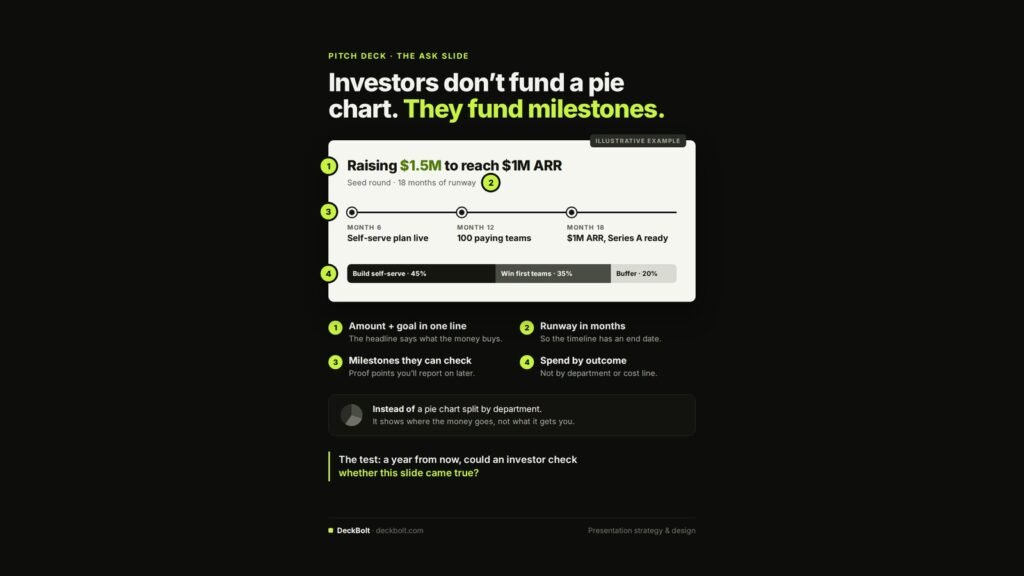
In the illustrative example, the slide reads:
- Headline: Raising $1.5M to reach $1M ARR
- Subhead: Seed round · 18 months of runway
- Timeline: Month 6, self-serve plan live. Month 12, 100 paying teams. Month 18, $1M ARR, Series A ready.
- Spend: build self-serve 45%, win first teams 35%, buffer 20%
The four elements
1. Amount and goal in one line
The headline says what the money buys. “Raising $1.5M to reach $1M ARR” is a claim an investor can evaluate. “Our Ask” is a label.
2. Runway in months
So the timeline has an end date. Runway tells investors when you will next need to raise, and what you must have achieved by then.
3. Milestones they can check
Proof points you will report on later. Each milestone should be specific enough that, in a board update, it is clearly either done or not done.
4. Spend by outcome
Not by department or cost line. “Build self-serve” and “win first teams” connect spending to the milestones above. “Engineering” and “Marketing” do not.
The test
A year from now, could an investor check whether this slide came true? If yes, it is a good ask slide. If the only honest answer is “we spent it”, rebuild it around milestones.
The figures above are an illustrative example. For a deeper walkthrough, see Your Use-of-Funds Pie Chart Answers the Wrong Question.
Preparing to raise? Send your deck for a free deck review, or see how to present financials without losing the room.