
The brief
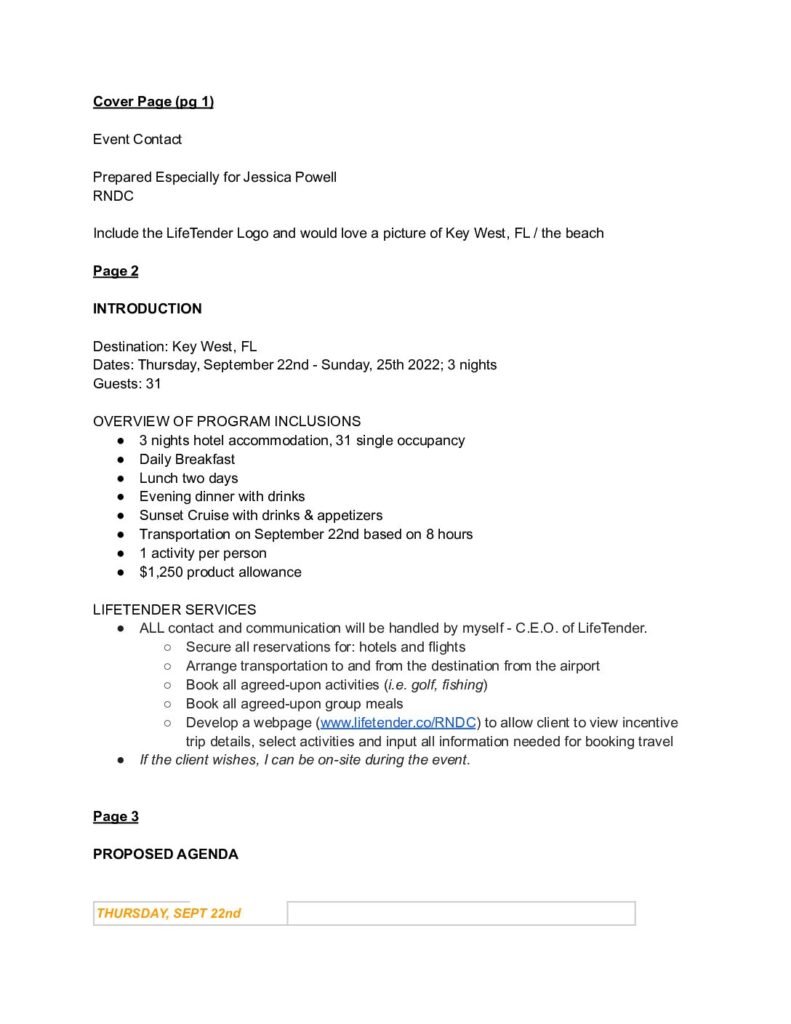
This event deck presents LifeTender’s incentive-trip proposal for RNDC, a distributor conference audience: a three-night programme in Key West, Florida, running Thursday 22 to Sunday 25 September 2022, for 31 guests. It was designed for big-screen legibility — a conference reveal, where the deck is the moment the trip gets announced — while carrying the full programme in enough detail for the organisers to approve it.
The content is the trip itself: flights from Washington DC via Miami, single-occupancy rooms at The Perry Hotel Key West, daily breakfast, lunches on two days, an evening dinner with drinks, a sunset cruise with drinks and appetisers, ground transportation, one activity per person, and a product allowance — with LifeTender handling every reservation behind it.
The challenge
A conference deck has seconds per slide and an audience at the back of a room. Whatever cannot be read at twenty metres might as well not be on the slide. But a programme proposal is also an operational document: the client approving it needs the actual detail — which hotel, which nights, what’s included, what’s hosted, what happens on which day. Strip the detail for the screen and the deck can’t do its approving job; keep all of it and the reveal falls flat.
There is also a sequencing problem. A trip programme is a story told in days — arrival, first full day, the big evening, departure — and the deck has to let the audience feel that arc while keeping each day’s logistics exact.
What we did
Destination photography does the emotional work: full-bleed Key West imagery — the marina, the water, the sunset the cruise is timed for — inside LifeTender’s dark teal and orange system, with the proposal cover personalised to its recipient at RNDC. The trip is sold by its pictures before a single detail is read.
The detail is then organised for distance. The agenda is set as a day-by-day grid — Thursday through Sunday — with times and events in large, consistent type that holds up from the back row. Inclusions are grouped rather than listed in prose: accommodation, food and beverage, activities, transfers and services, each readable as a block, so a viewer can verify “is dinner covered?” in seconds. LifeTender’s role closes the deck explicitly — one point of contact managing reservations, transportation, activities, meals and a dedicated webpage for trip details — because for the organiser, that single slide is the difference between approving a vendor and adopting a second job.
The deck
The deck works in both of its lives: projected, where it announces the trip with the energy the trip deserves, and re-read afterwards as the programme of record. Big type, one idea per slide, photography carrying the destination, logistics carried by structure — the same rules we apply to any event deck, tested here against the hardest version of the job: a room full of people who sell experiences for a living.
Planning an event your audience has to feel from the back row? Our pitch deck design services include event and keynote decks, and presentation design pricing shows the fixed-scope packages.