
The brief
This investor deck was built for Leaf Energy, a fleet electrification solutions provider — a technology company whose products are physical: delivery e-bikes, intelligent swappable batteries, charging stations, and the software that runs a fleet on top of them. The brief’s core requirement is the one we state on our Projects page: carry a technical product into a non-technical room.
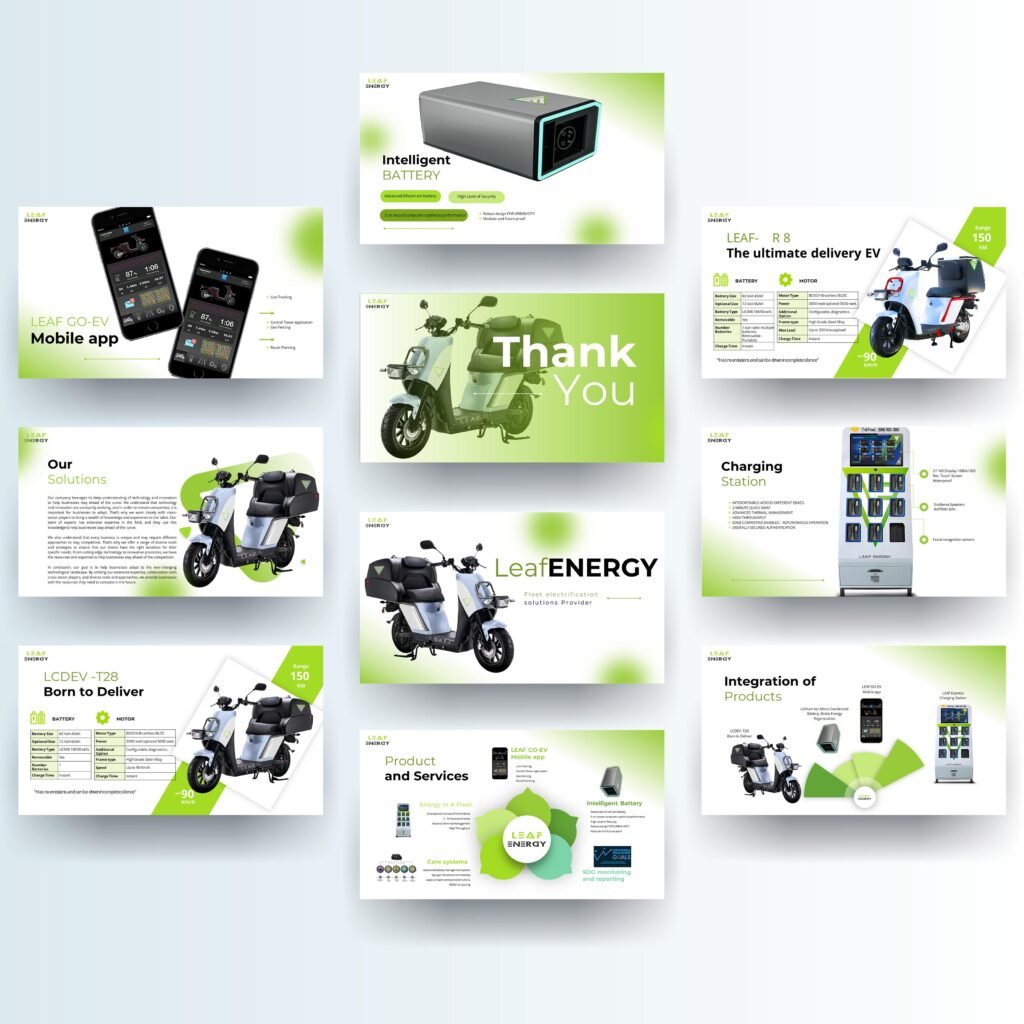
The range the deck presents includes the LCDEV-T28 delivery e-bike (“Born to Deliver”) and the LEAF-R8, an intelligent battery with on-board computing, charging stations built for quick battery swaps, and the Leaf Go-EV mobile app — live tracking, geo-fencing and route planning for fleet operators.
The challenge
Hardware decks have a gravity problem: specifications pull every slide down to a spec sheet. Battery capacities, motor data, charge times — fleet buyers need all of it, and technical founders are rightly proud of it. But investors are not buying a bike; they are buying a system and a market. A deck that reads as four product datasheets never assembles into the thing that makes the company valuable: the integration — vehicles, energy and software working as one fleet platform.
The opposite failure is just as common: a vision deck so light on substance that a diligent investor can’t find the engineering. The design problem was to keep the technical depth visible and checkable, while fencing it so it never interrupts the investment story.
What we did
We presented the range as one integrated system first, and as products second. A product-integration layout ties the whole offer together — delivery vehicle, intelligent battery, mobile app, charging station — in a single diagrammatic slide, so the investor grasps the platform before meeting any component. Only then does each product get its hero moment: the delivery e-bikes photographed large, with their battery and motor specification tables set in a consistent grid — the same columns in the same positions on every product slide, so specs can be compared across the range without re-reading the layout each time.
The intelligent battery and the charging station get the same treatment: product first, capability bullets in plain language (quick swaps, interoperability across e-bikes, secured access), technical detail present but contained. The Go-EV app is shown in hand, on phones, with its tracking screens visible — the software made tangible for a reader who will never operate the fleet themselves. A sustainability thread also runs through the product story: the services layout includes SDG monitoring and reporting for fleet customers, which matters to investors screening technology companies for measurable impact alongside returns. Technical content stays on the page; it just stops being the page’s structure. The structure is the investment story, told in the order investors ask their questions.
The deck
The design is fresh and confident — white space, a vivid green identity, and photography of the actual vehicles carrying the slides. It reads as a consumer-tech deck on the surface and an engineering document underneath, which is exactly the double register a hardware company needs in the room.
If your product is technical and your audience isn’t, the deck is the translation layer. That’s the core of our pitch deck design services — and presentation design pricing shows the fixed-cost packages before you start.