
The brief
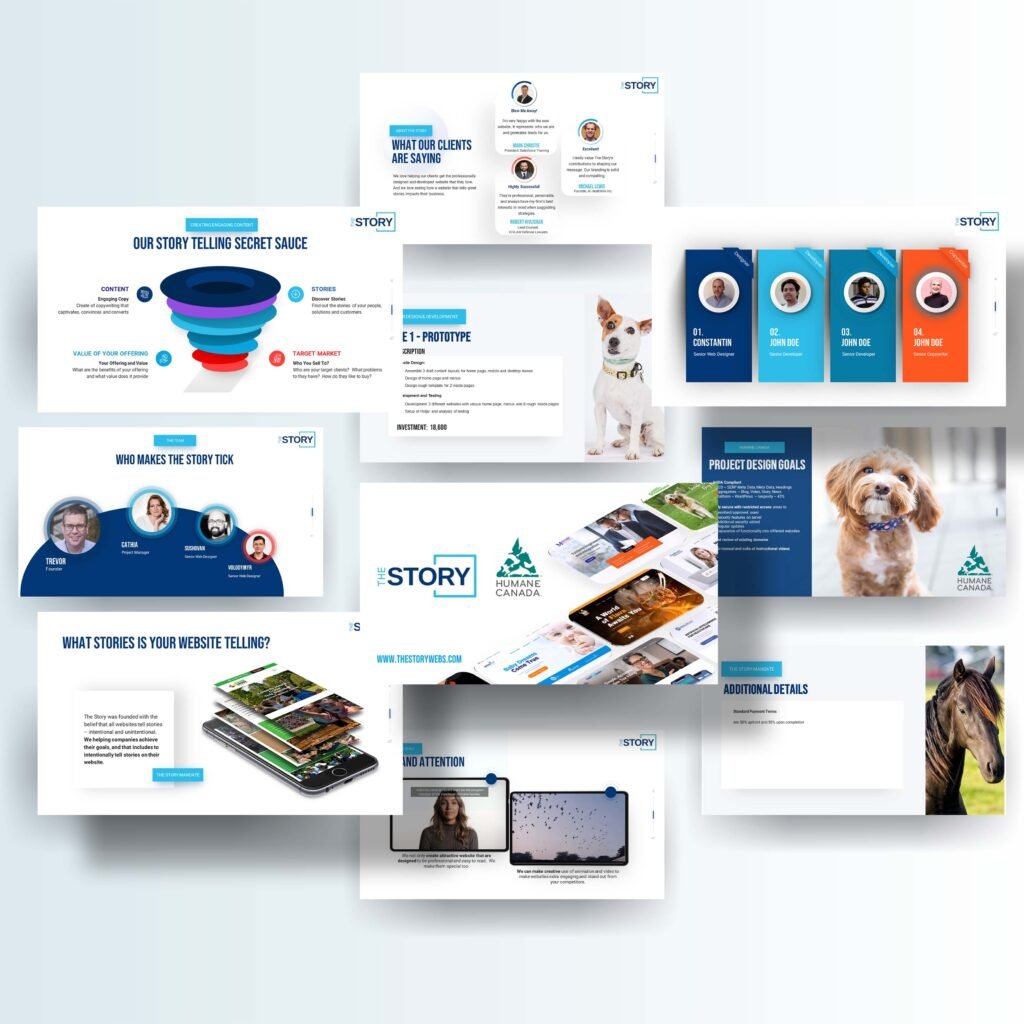
The Story (thestorywebs.com) is a digital storytelling platform — a business that helps companies tell their stories online — and it needed an investor pitch deck. The defining decision for this project was made before design began: the deck would be designed around narrative rather than features.
That sounds like a stylistic preference. It isn’t. For a company whose product is storytelling, the deck is the audition. A standard feature-led SaaS deck — modules, dashboards, pricing tiers — would have contradicted the product on every slide. The deck had to demonstrate the thing it was selling, while still doing the unglamorous work every investor deck must do: establish the problem, explain the method, introduce the team, show proof, and make the ask.
The challenge
Storytelling companies face a specific credibility risk: investors have heard “we’re storytellers” from a hundred agencies, and the claim costs nothing to make. The deck had to show the method working — a visible process, real client work, real client words — rather than asserting it beautifully.
There is also a structural challenge. Narrative decks drift. Without discipline, a story-first deck becomes a mood piece: lovely to sit through, impossible to summarise afterwards, and useless when forwarded to a partner who wasn’t in the room. This deck needed a narrative spine strong enough that an investor could retell it — the funnel from content, to stories, to the value of the offering, to the target market — in one sentence.
What we did
The deck opens with a question instead of a claim: “What stories is your website telling?” It’s the question the company asks its own clients, and it puts the investor in the client’s seat immediately — most investors run portfolio companies whose websites answer that question badly.
The method is then presented as the company’s own framework, “Our Story Telling Secret Sauce”: a funnel that moves from content, through stories, to the value of the offering and the target market — the mechanism by which storytelling becomes commercial rather than decorative. The team slide (“Who makes the story tick”) introduces the people as characters with roles, because a storytelling company’s team page should read like one. Proof follows in the clients’ own format: testimonial slides, and a project slide walking through design goals for client work — including a project for Humane Canada — so investors can see how the method lands on a real brief. The deck closes on the company’s mandate, restating what it exists to do.
The deck
The design is deliberately the opposite of a dense SaaS deck: a light blue-and-white system, generous white space, and room for the words to breathe — the confidence of a company that believes its sentences can carry a slide. Headlines still state each slide’s point, so beneath the narrative the standard investor logic holds: problem, method, team, proof, mandate.
A pitch deck for a storytelling company should be its best story. If your deck has to prove your product while it pitches it, that’s a design problem we solve often — see our pitch deck design services, and presentation design pricing for fixed-scope packages.