
The brief
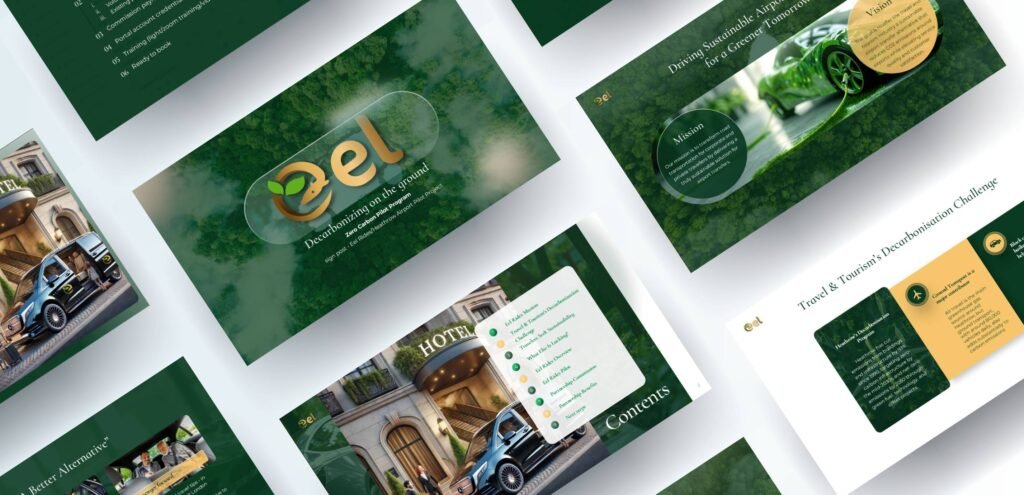
Eel Rides is a zero-carbon airport transfer venture, and this deck is its partnership and investment case, structured around the environmental argument. At its centre sits a concrete proposal: a pilot project with Heathrow Airport — “Decarbonising on the ground,” the Zero Carbon Airport Pilot Program — positioning Eel’s sustainable transfer service inside one of the world’s most scrutinised airport decarbonisation programmes.
The company describes its mission as transforming road transportation for companies and private travellers with a sustainable solution for airport transfers, and its vision as a nationwide alternative that reduces CO2 emissions around airports. The deck had to carry that ambition, the wider decarbonisation challenge in travel and tourism, and a working partnership offer — pilot structure, partnership commission, benefits and next steps — in one document.
The challenge
Partnership decks for sustainability ventures have to win two arguments at once, and leading with either one alone loses. Lead with the environment and a commercial partner files you as advocacy: worthy, unfunded, someone else’s problem. Lead with the commerce — commission, benefits, terms — and you’ve undersold the only reason this partner should move now, which is that airports are under visible pressure to decarbonise the ground as well as the sky, and Heathrow has a programme of its own to deliver.
The audience sharpens the problem. An airport partner reads decks from every category of supplier. The environmental case has to be framed in the airport’s own context — its decarbonisation commitments, its ground-transport problem — not as generic climate language, while the commercial ask has to be specific enough to act on in the same reading.
What we did
The deck opens with mission and vision, stated in the company’s own words and given full slides of their own — for a venture like this, purpose is not decoration, it’s the pitch. Then it widens to the shared problem: the travel and tourism industry’s decarbonisation challenge, and Heathrow’s own decarbonisation programme, so the pilot appears as the airport’s next step rather than the startup’s favour.
The ask is structured as a contents-led sequence the reader can follow and retell: what Eel is looking for, the Eel Rides pilot, the partnership commission, the partnership benefits, and the next steps. Each element gets its own space, because a partnership decision gets made by several people reading at different times — the deck has to let each of them find the part they own. British spelling is used throughout (“decarbonisation,” “organisation”), matching the client’s UK context and the airport’s own publications.
The deck
The design runs deep green and gold with forest and vehicle photography — sustainability rendered as premium rather than worthy, which matters when the partner is a global travel hub and the service competes with established transfer brands on the same page. Clean contents structure, one idea per slide, headlines that state the point: the environmental case argued with the discipline of an investment deck, because that is what it is.
Building a partnership case where purpose and commerce both have to land? That’s a structure problem before it’s a design problem. Our pitch deck design services cover partnership decks end to end, and presentation design pricing shows the fixed-scope packages.