
The brief
Evolya is an AI-powered career-matching platform, and its investor deck had to do something most decks never attempt: sell one product to three different buyers at the same time. The platform serves consumers choosing or changing careers, businesses managing their own people’s careers, and government institutions responsible for orientation and reclassification at scale — B2C, B2B and B2G in a single story.
The product itself is a guided journey rather than a job board: a test, a profile analysis, and a personalised action plan. The deck, designed in PowerPoint, had to explain that journey, prove there was a real problem behind it, and position a startup against the established names in career guidance — all in a format an investor could read quickly and forward without anything getting lost.
The challenge
Three audiences read the same deck with three different sets of questions. A student or job-seeker asks: will this help me find direction? An HR team asks: can this move our people internally instead of losing them? A government institution asks: does this work for thousands of people, not dozens? A single narrative had to hold all three without blurring into a deck that speaks to everyone in general and no one in particular.
The competitive slide raised the stakes further. The deck sets Evolya alongside names every investor already knows — Pôle Emploi, Welcome to the Jungle, Chance and others. Against that field, a vague claim of “AI-powered matching” would not survive. The positioning had to be specific: what the product does, step by step, and why the experience feels different from a listings site.
What we did
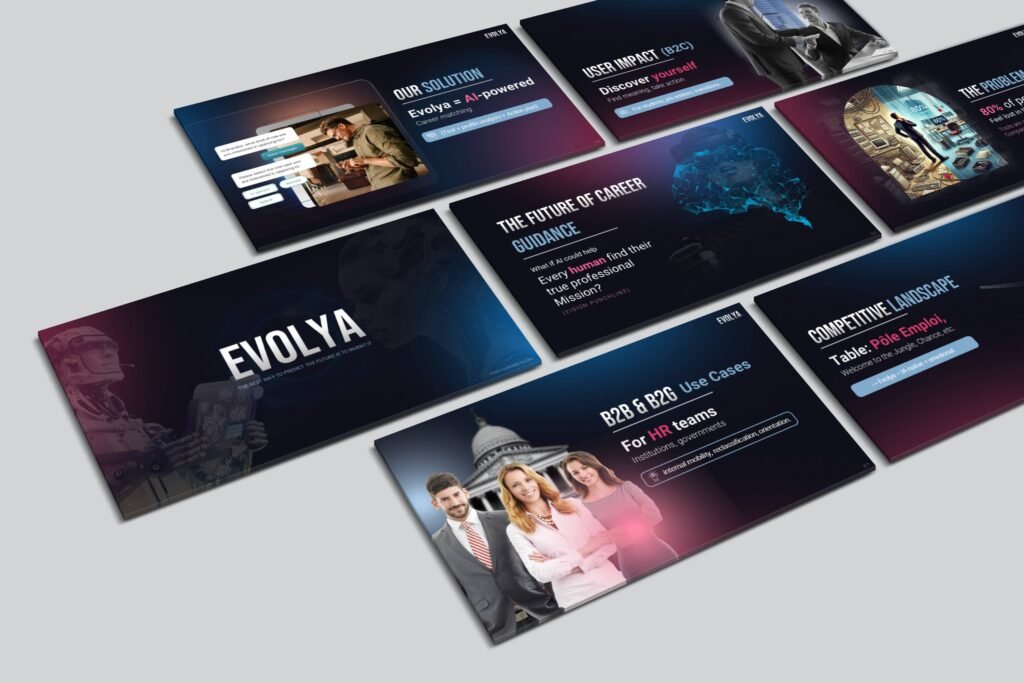
We structured the deck in the order investors decide, not the order the product was built. The problem comes first, then the solution stated in one line — “Evolya = AI-powered career matching” — broken into its three working parts: the test, the profile analysis and the action plan.
From there, each audience gets its own section, written in its own language. The consumer section leads with self-discovery: “Discover yourself — find meaning, take action,” aimed at students, job-seekers and people in transition. The B2B and B2G section switches to operational terms an HR director or institution recognises — internal mobility, reclassification, orientation — because that is the vocabulary those buyers budget in.
A vision slide carries the mission as a question an investor can repeat in their own words: “What if AI could help every human find their true professional mission?” And the competitive landscape is laid out as a clean comparison table, so the positioning reads as analysis rather than assertion. As with every DeckBolt build, each headline states the point of its slide, so the argument survives a skim-read of the PDF.
The deck
The design is dark and editorial — deep navy and burgundy gradients, condensed all-caps typography, and a high-energy, future-facing tone that matches the product’s ambition. The cover is built around the name and a single line: “The best way to predict the future is to invent it.” Product screens show the assessment conversation in progress, so the platform feels real rather than diagrammed.
The deck was delivered natively in PowerPoint, fully editable, so the founders can update their story between investor meetings without coming back to a designer.
Preparing a raise of your own? This is the kind of build covered by our pitch deck design services — storyline, design and native files — and our presentation design pricing shows the fixed-scope packages before you commit to anything.