
The brief
GymGuyz — the Central Monmouth County franchise of the mobile fitness business — sells workplace fitness and wellness programmes to employers, and needed a commercial presentation for enterprise sales conversations: a deck its team could present to HR and leadership buyers, and leave behind to survive procurement review.
The offer is a service, not a product, which makes the deck carry more weight than usual. There is nothing to photograph on a shelf; the buyer is purchasing a programme that will run inside their workplace, with their staff, on their premises or over video. The deck has to make that future feel concrete, structured and safe to approve.
The challenge
Corporate wellness is a crowded pitch. Every employer of any size has seen vendor decks promising healthier, happier teams, and buyers — HR leads, office managers, finance approvers — are practised at discounting them. The client’s real argument is economic: unwellness at work has a cost, in absence, in presenteeism, in turnover, and a programme is cheaper than the problem.
But a deck that opens with a sales pitch for fitness sessions loses that argument before it starts. The sequence matters: the buyer has to feel the cost of the status quo first, then see a programme menu broad enough to fit their workforce — in-person and virtual, different types of training and wellness activity — and then believe the provider behind it is established enough to deliver.
What we did
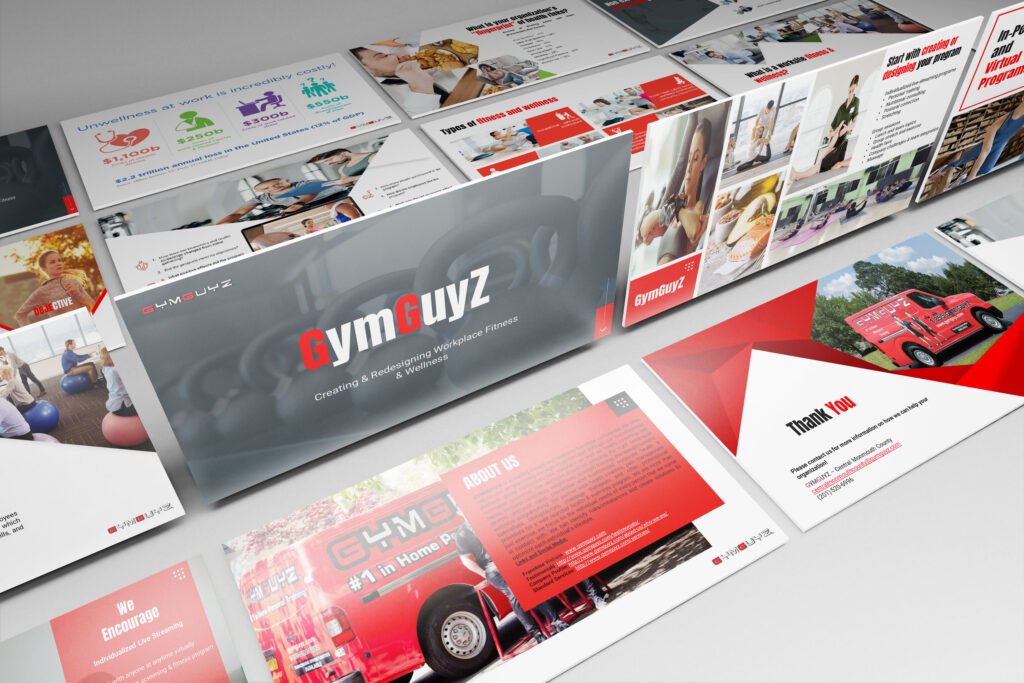
We structured the deck problem-first. It opens with the client’s case on the cost of unwellness at work, set as a stat-led slide designed to be quoted in the internal conversation that happens after the meeting — because in enterprise sales, your deck’s second presentation is the one the buyer gives on your behalf.
From there, the deck lays out the types of fitness and wellness the programme covers, then the delivery formats — in-person sessions and virtual programmes — so a buyer can picture the offer inside their own workplace rather than in the abstract. An about section establishes the business, and the deck closes with a clear thank-you and contact slide: one next step, easy to find when the file is reopened weeks later. Every slide carries a single idea in large type, on the principle that sales decks are read at least as often as they are presented, usually on a laptop screen, usually fast.
The deck
The design works in the brand’s bold red and white, with photography of actual training sessions doing the persuading — real coaches, real workplaces, no stock-fitness gloss. The system is confident without being aggressive: strong headlines, clean panels, and enough white space that a procurement reviewer can find any detail again in seconds.
That is the test of an enterprise sales deck — not whether it impresses in the room, but whether it still makes the case on the tenth forward, without anyone there to explain it. If yours has to do the same, our pitch deck design services include sales decks built for exactly that journey, and presentation design pricing shows the fixed-scope options.