
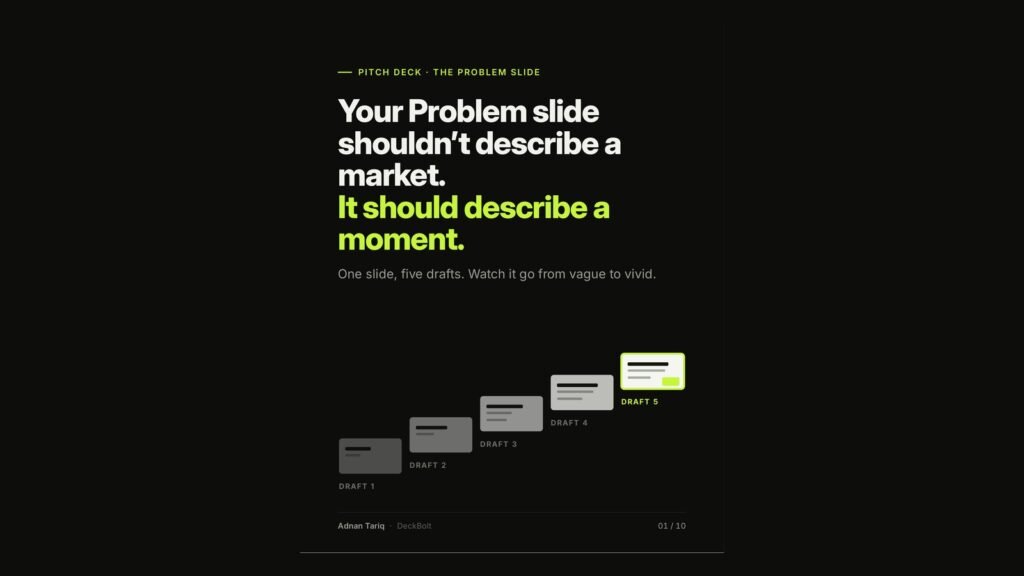
Most problem slides describe a market: “Restaurant inventory is broken.” It is true, and it tells an investor nothing new. The strongest problem slides describe a moment instead, one an investor can picture, feel and put a price on.
Here is one illustrative problem slide, rewritten five times, going from vague to vivid.
Draft 1: the category
“Restaurant inventory is broken.”
A category, not a problem. It is true for every restaurant, so it tells an investor nothing new.
Draft 2: the big stat
“Restaurants lose $[X]B to food waste every year.”
Big, but abstract. Nobody feels a billion. A huge number with no person behind it is just noise.
Draft 3: the person
“Independent restaurant owners can’t see what’s in stock.”
Now there is someone to care about. A specific buyer makes it real. But when does it actually hurt?
Draft 4: the moment
“Every Sunday night, owners count stock by hand. On paper. For two hours.”
Now investors can picture it. A scene is easier to believe than a statement.
Draft 5: the cost
“Every Sunday night, owners count stock by hand, then over-order to be safe.” Underneath: roughly $1,200 of food wasted, every month.
Person, moment and cost. Now the pain has a price, and the solution has a job to do.
The formula: four things a strong problem slide names
| What it is | In the example | |
|---|---|---|
| Who | A specific buyer | Independent restaurant owners |
| When | The moment it hurts | The Sunday-night stock count |
| Today | Their workaround | Paper counts, then over-ordering |
| Cost | In their numbers | Food wasted every month |
Together they make a problem investors can see, feel and price.
Same slide, different job
Designed, draft 5 becomes a headline (“Every Sunday night, owners count stock by hand, then over-order to be safe”), a simple three-step flow showing the workaround (count on paper → guess → over-order), and one large figure: $1,200 of food wasted per restaurant, every month. Draft 1 labels a market. Draft 5 gives the investor something to picture.
Before you design your problem slide, ask
- Can I name the person who has this problem?
- Can an investor picture when it happens?
- Do I show what they do about it today?
- Is the cost in their numbers, not the industry’s?
Four yeses, and your solution slide finally has something to solve.
This is an illustrative example, not a real company. For the order the rest of the deck should follow, see Pitch Deck Structure.
Is your problem slide a category or a moment? Send us your pitch deck for a free deck review. We will review the story, the structure and the design, and tell you what to fix first.