
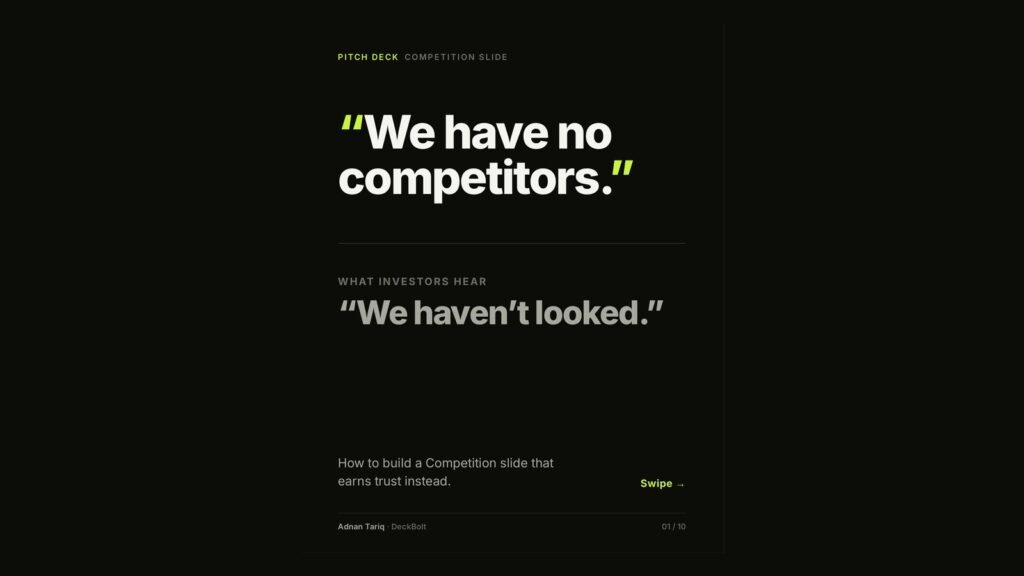
“We have no competitors” is meant to sound confident. What investors hear is “we haven’t looked.” A competition slide that earns trust starts from a simple fact: your customer always has an alternative.
Your customer always has an alternative
Even if no startup does exactly what you do, people are solving the problem somehow today:
- A spreadsheet: free, familiar, already open.
- An agency or freelancer: pay someone to handle it.
- An in-house hire: make it someone’s job.
- Doing nothing: live with the problem.
“Doing nothing” is often the one you have to beat.
Two common versions that backfire
The checkmark table
When you win every row, nobody believes the rows. The rows were picked because you already have those features, and every rival is reduced to a column of crosses.
The rigged 2×2
If the axes were chosen so you win (“the thing we’re best at” against “the other thing we’re best at”), investors can tell. Sitting alone in the top-right with an empty chart around you does not read as leadership. It reads as a drawing.
Move 1: start with how customers solve it today
List the real alternatives, including the non-startup ones, and give each one honest credit. An illustrative example:
| Option | Good at | Breaks when |
|---|---|---|
| Spreadsheets | Free, flexible | The team grows |
| Agency | Expert output | Budget or speed matters |
| Legacy software | Deep features | You need it live this quarter |
| Doing nothing | No cost today | The problem compounds |
Move 2: map the trade-off buyers actually make
Pick axes from what customers weigh when they choose, and let every option win somewhere. In the example, the axes are “faster to set up” and “handles more scale”. Legacy software wins on depth, the agency wins on expertise, spreadsheets win on speed to start, and you sit where you genuinely fit: for teams outgrowing spreadsheets.
Move 3: say why you win, and why it lasts
Complete two sentences:
- We win when [this customer] needs [this outcome] without [this trade-off].
- It is hard to copy because [what compounds for you]: data, distribution, workflow or know-how.
A position without a reason it lasts is a head start, not an advantage.
Same slide, different credibility
The “before” is a checkmark table titled “Competition”. The “after” leads with a headline (“Teams run this on spreadsheets today. We win when they outgrow them.”), a fair trade-off map, and two short lines: when you win, and why it is hard to copy.
Before you send it, check
- Did we name how customers solve it today?
- Does every option get credit for something?
- Are the axes what buyers actually weigh?
- Can we say why we win in one sentence?
- Would a competitor call this slide fair?
If any answer is “not really”, start there. For three alternative formats, see Stop Putting Yourself in the Top-Right Corner.
Want a second pair of eyes on your pitch deck? Send it over for a free deck review. We will tell you what we would change first, and why.