
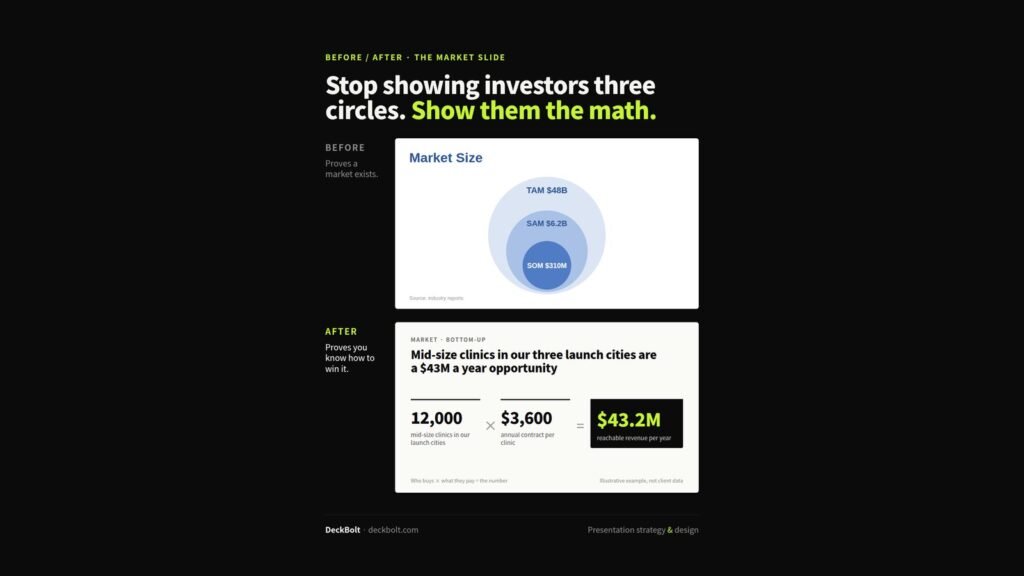
The market slide in most pitch decks looks the same: three nested circles labelled TAM, SAM and SOM, a large number in the outer ring, and a source line that says “industry reports”. Investors have seen hundreds of them, and they tell them very little.
Before: proves a market exists
Three circles reading TAM $48B, SAM $6.2B and SOM $310M show that a market is out there. They do not show that you understand who buys, why, or how you will reach them. The numbers come from someone else’s research, so they say nothing about your plan.
After: proves you know how to win it
A bottom-up market slide builds the number from things you can defend:
Who buys × what they pay = the number.
In the illustrative example, the headline makes a specific claim: “Mid-size clinics in our three launch cities are a $43M a year opportunity.” Underneath, the slide shows the math:
- 12,000 mid-size clinics in our launch cities
- × $3,600 annual contract per clinic
- = $43.2M reachable revenue per year
The number is smaller than $48 billion, and that is the point. It is believable, because an investor can check each input, and it shows you have thought about exactly who your first customers are.
How to build yours
- Define the customer precisely. Not “healthcare”, but the specific segment and geography you will sell to first.
- Count them. Use a source you can name and an investor can verify.
- Price it. Use your actual or planned annual contract value.
- Multiply, and make the result the headline. State it as a sentence, not a label.
You can still mention the larger market for context, but lead with the number you can actually reach. For more on why most TAM slides fall flat, see Market Size Slides: Why Most TAM Slides Fail.
The figures above are an illustrative example, not client data.
Want your market slide to hold up under questions? Send your deck over for a free deck review.