
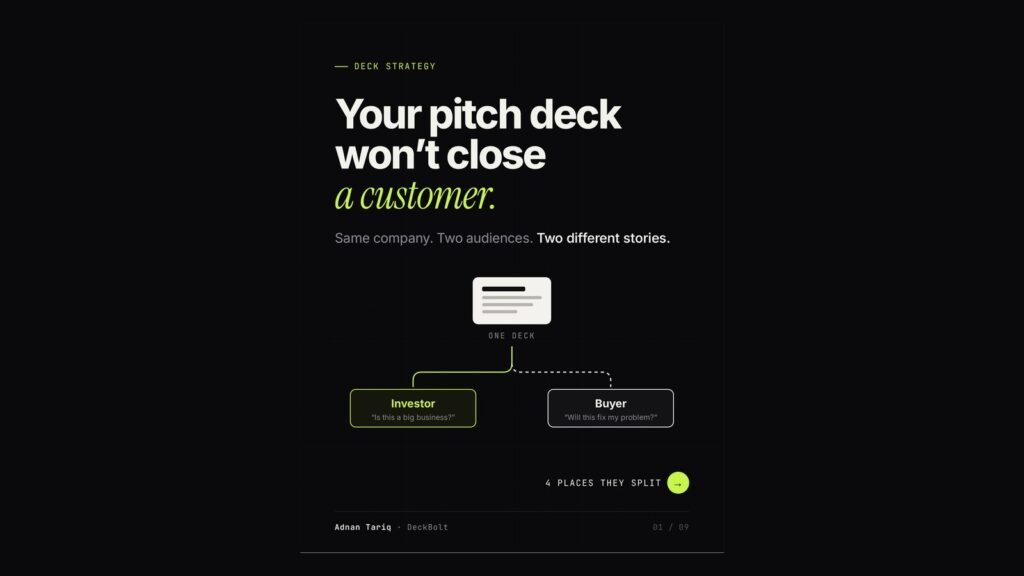
It is tempting to send prospects the same deck you send investors. It is your best-designed document, it explains the company, and it is already finished. But an investor deck is built to answer a different question, and a buyer can tell.
Same company. Two audiences. Two different stories. (We have covered the broader differences in Sales Deck vs Pitch Deck; this piece looks at the four specific places the storyline splits.)
Start here: they are reading for different answers
- The investor asks: “Can this become a very large business?”
- The buyer asks: “Will this fix my problem without creating a new one?”
Every slide should answer the question its reader is actually asking.
Split 1: Who is the hero?
In an investor deck, the hero is your company. Team, traction and momentum carry the story.
In a sales deck, the hero is the customer. You are the guide who gets them to a better place.
Split 2: Where the story starts
An investor deck opens with a big problem in the market, framed so the opportunity feels large.
A sales deck opens with the buyer’s situation today, and what staying there is quietly costing them.
Split 3: What counts as proof
Investors want evidence the business can scale: traction, growth, market size and team.
Buyers want evidence it works for someone like them: similar customers, results in their terms, and a credible rollout plan.
Split 4: How it ends
An investor deck ends with the raise and what it unlocks: a clear amount tied to clear milestones.
A sales deck ends with a small, low-risk next step. A pilot, a workshop, a second call. Not “sign here.”
Two storylines, side by side
The same facts can appear in both decks. The order and emphasis change.
| Investor deck | Sales deck |
|---|---|
| 1. Market problem | 1. Their world |
| 2. Solution | 2. Cost of standing still |
| 3. Market size | 3. A new approach |
| 4. Traction | 4. Proof from peers |
| 5. Team | 5. Rollout plan |
| 6. The raise | 6. Next step |
Good news: you do not start from zero
Reuse the design system. Rebuild the narrative.
- Reuse: brand and slide templates, product visuals, chart styles and core data.
- Rebuild: the slide order, every headline, the proof you lead with, and the ask.
Not sure your deck is telling the right story for the room? Send it over for a free deck review. We will tell you who it is really written for, and what we would change for the audience you are facing.